

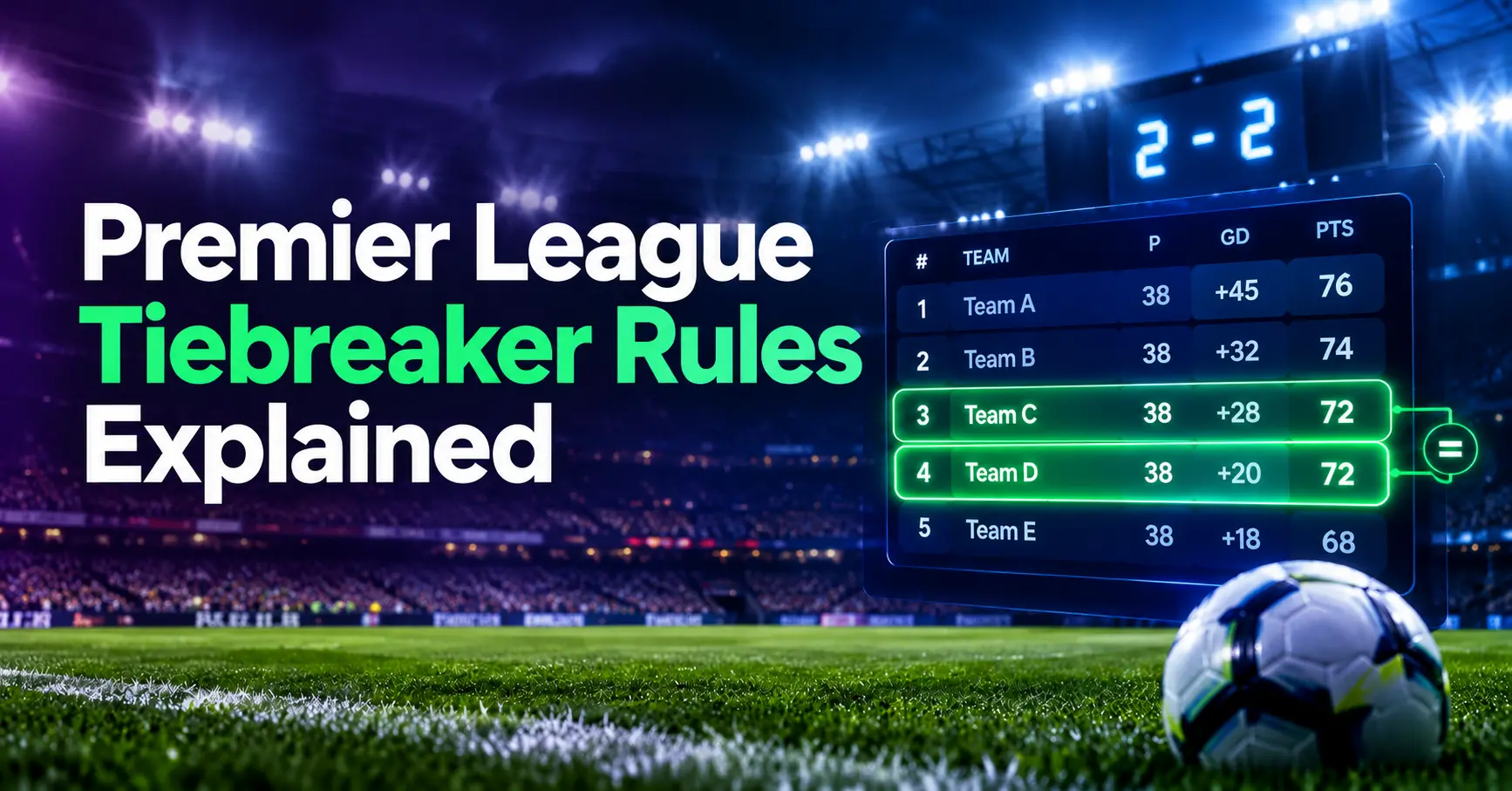
Two Premier League clubs finish the season on exactly the same points. One celebrates, and the other wonders what went wrong. So what actually separates them? The answer lies in the Premier League tiebreaker rules. They set a strict order for splitting level teams, from goal difference down to a rare play-off. This guide explains every step, with real examples and a few quirks most fans miss.
What Happens If Two Teams Have the Same Points in the Premier League?
Goal difference decides it first. The club with the better goal difference finishes higher in the league table.
If goal difference is level too, the rulebook checks goals scored. After that, it looks at the head-to-head record between the tied clubs. The Premier League same points rule covers every position, from first place to twentieth.
It matters more often than people think. At the end of 2025–26, three separate pairs of mid-table clubs finished level on points. Goal difference split every pair, as the final 2025–26 table shows.
How Is the Premier League Decided If Teams Are Tied?
Points come first, and a fixed sequence handles any ties. That sequence sits in Rule C.17 of the Premier League Handbook.
Each club plays 38 matches. A win earns three points, a draw earns one and a defeat earns none. Premier League tiebreakers only come into play when those totals are identical.
In most seasons, points alone settle the big questions. The Premier League tie breaker steps exist for the rare, nail-biting exceptions.
Premier League Tiebreaker Rules: The Full Order
The Premier League’s own explainer lists the handbook criteria in this order:
- Goal difference
- Goals scored
- Points won in head-to-head matches
- Away goals scored in head-to-head matches
- A play-off match
The Premier League tiebreaker rules work in strict sequence. Each step only applies if the one before it fails to separate the clubs. Here’s how each one works.
Step 1: The Premier League Goal Difference Rule
Goal difference is goals scored minus goals conceded across all 38 games. A team that scores 70 and concedes 30 has a goal difference of +40.
It can drop below zero, too. A side that scores 40 and concedes 55 sits on -15.
The Premier League goal difference rule rewards consistency. Every goal counts, whether it comes in a 5-0 thrashing or a tense 1-0 win. That’s why managers sometimes chase late goals in games they’ve already won.
Step 2: The Premier League Goals Scored Tiebreaker
If goal difference is level, the club with more goals for finishes higher. A tight defence gets no extra credit at this stage.
English football’s most famous example came before the Premier League began. In 1988–89, Arsenal and Liverpool finished level on points and goal difference in the old First Division. Arsenal took the title because they had scored more goals. Michael Thomas sealed it with a stoppage-time winner at Anfield on the final night.
The Premier League goals scored tiebreaker has never decided a title since the league launched in 1992.
Step 3: The Premier League Head-to-Head Rule
If the clubs still can’t be split, the rulebook looks only at their meetings with each other. Only points from those two games count.
Say Club A beat Club B 2-1 at home and drew 1-1 away. Club A earns four head-to-head points, while Club B earns one. Club A finishes higher.
The Premier League head-to-head rule sits third in line. That sets England apart from several other big European leagues.
Step 4: Away Goals in Head-to-Head Meetings
Next come away goals, but only from the games between the tied clubs. The side that scored more goals on the road in those meetings goes ahead.
This surprises many fans. UEFA scrapped the away goals rule in its club competitions from 2021–22. The Premier League still keeps it as a late tiebreaker.
Step 5: A Premier League Play-Off for Teams on the Same Points
If nothing else works, the clubs meet in a one-off play-off at a neutral ground. The Premier League Board sets the format, timing and venue, as Sky Sports explains.
The handbook doesn’t name a stadium. Many fans assume Wembley would host it, but nothing guarantees that.
A play-off only happens when the position really matters, which means the title, relegation or European qualification. No Premier League play-off has ever taken place.
Premier League Teams Level on Points and Goal Difference: Famous Near Misses
2011–12: The Only Premier League Title Decided on Goal Difference
Manchester City and Manchester United both finished on 89 points. City won the league with a better goal difference, +64 against United’s +56. It remains one of the standout moments in Premier League records and statistics.
The final day was unforgettable. City trailed QPR 2-1 heading into stoppage time. Edin Džeko equalised, then Sergio Agüero struck at 93:20 to win it 3-2.
United had already won at Sunderland. Their players learned the news while still on the pitch.
2023–24: The Play-Off That Became Possible
In April 2024, Sky Sports flagged that a first-ever title play-off was mathematically possible. Liverpool and Manchester City had drawn both of their meetings 1-1. That left them level on head-to-head points and away goals.
In the end, City won the title outright, and no play-off was needed.
2025–26: Level on Goal Difference in the Run-In
Late in the 2025–26 title race, Arsenal and Manchester City sat level on goal difference at +43. The Premier League even published an explainer on whether goal difference could decide the title. It didn’t, as Arsenal wrapped up the title before the final day and finished with 85 points.
Why the Premier League Uses Goal Difference Instead of Head-to-Head
How the Premier League Tiebreaker Rules Compare With Europe
Spain’s La Liga checks head-to-head results first. Italy’s Serie A also leans on head-to-head. Germany’s Bundesliga, like England, puts goal difference first.
The English Football League, including the Championship, shares the same first three steps. It then adds extra checks, including total wins, away goals and disciplinary penalty points.
Supporters of goal difference say it rewards a whole season’s work. Critics argue that head-to-head makes big clashes feel even bigger. Both sides have a fair point.
Do the Same Rules Apply to Relegation and European Places?
Yes. The Premier League relegation tiebreaker works exactly like the one for the title. The same order decides Champions League, Europa League and Conference League places.
Those European spots now lead into a very different format. Our guide to the Champions League league phase explains what happens next.
At the other end, a relegation battle could, in theory, end in a survival play-off. It would follow the same process as a title decider. Big names aren’t safe either, as Tottenham’s struggles near the relegation zone in 2025–26 showed.
How Points Deductions Affect Tiebreakers
A points deduction lowers a club’s points total, not its goals. A docked side keeps its full goal difference.
This matters in tight fights near the relegation zone. Everton and Nottingham Forest both received points deductions in 2023–24. Their goal difference stayed untouched throughout.
Helpful Tips for Following a Tight Run-In
- Check goal difference, not just points. A two-goal swing can move a club up or down the final standings.
- Look up head-to-head results early. Both meetings may have happened months before the final day.
- Remember the mini-league. When three or more clubs are tied, only results between those clubs count. Tournament football uses similar logic, as the ranking of third-placed teams at the 2026 World Cup showed.
- Watch the final day closely. All ten matches kick off at the same time, so the table can change every minute.
- Read the handbook each summer. The Premier League publishes a new edition every season.
Want to stay ahead of the run-in? Bookmark this page now, and share it with your group chat before the next tight finish.
Frequently Asked Questions
What is the first tiebreaker in the Premier League?
Goal difference is the first tiebreaker. The club with the higher goal difference finishes above any rival on the same points.
How is goal difference calculated?
Subtract goals conceded from goals scored. A team with 60 goals for and 45 goals against has a goal difference of +15.
Does the Premier League use head-to-head results?
Yes, but only as the third tiebreaker. It applies after goal difference and goals scored have failed to separate the clubs.
What happens if teams are level on points, goal difference and goals scored?
Head-to-head points decide it next. If those are equal, away goals in head-to-head meetings come into play.
Do away goals still count in the Premier League?
Yes, but only as the fourth tiebreaker. They count only in matches between the tied clubs.
Has there ever been a Premier League play-off?
No. A play-off has never been needed, though 2023–24 came close to making one possible.
Has a Premier League title ever been decided on goal difference?
Yes, once. Manchester City pipped Manchester United on goal difference in 2011–12.
How do tiebreakers work when three or more teams are level?
The rules create a mini-league. Only points from matches among the tied clubs count at the head-to-head stage.
Where would a Premier League play-off be held?
At a neutral ground chosen by the Premier League Board. The handbook doesn’t name a specific stadium.
Have the tiebreaker rules changed recently?
The core order has stayed stable in recent seasons. The head-to-head and play-off steps were already in place by 2023–24. Check each new handbook, since the league updates it every summer.
Final Whistle: Why These Rules Matter
In most seasons, points settle everything. But when two clubs finish level, a single goal scored in August can decide a title in May. Goal difference, goals scored, head-to-head, away goals and a play-off all wait in line. Knowing the Premier League tiebreaker rules turns a confusing table into a clear story. Save this guide now, and explore more football guides before the run-in heats up.