
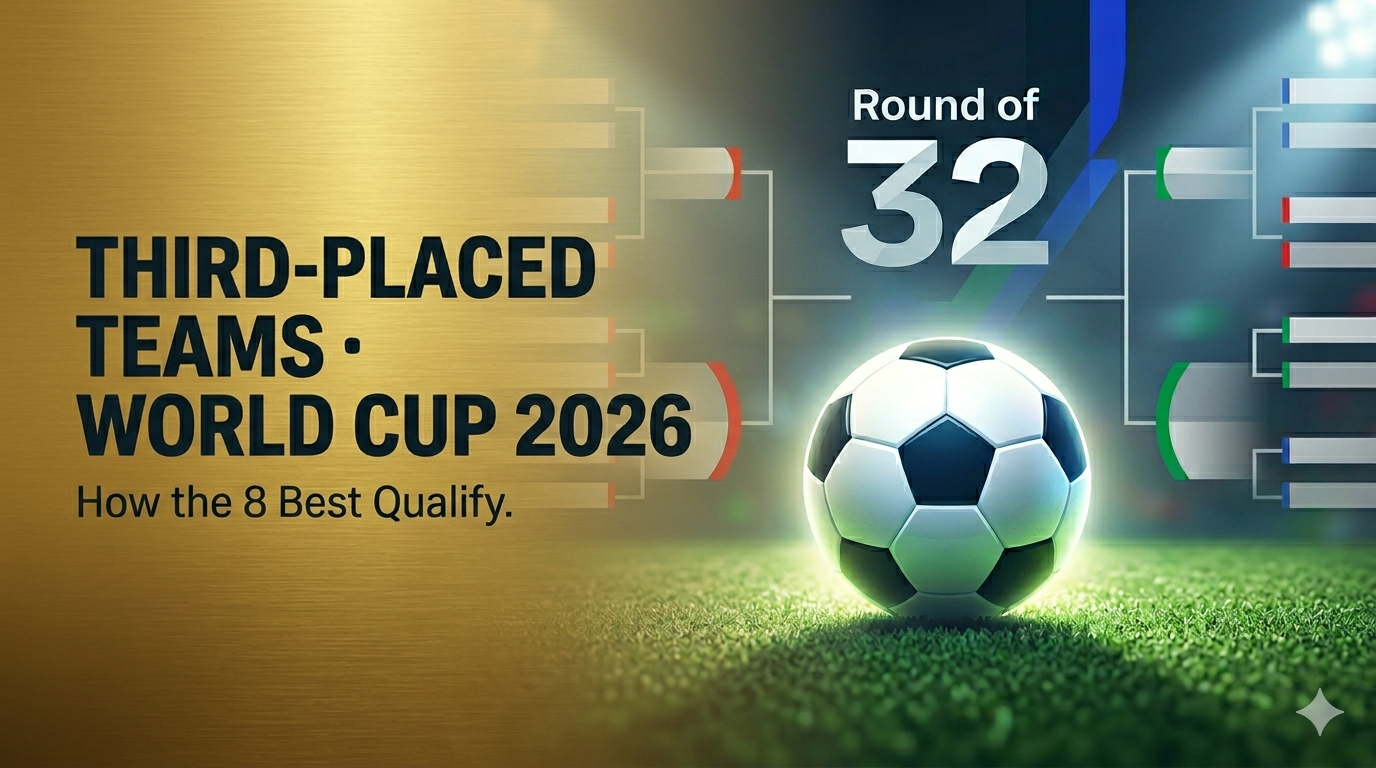
Football’s biggest summer just gained a fascinating new twist. The third-placed teams World Cup 2026 storyline has fans glued to the group standings. For the first time, finishing third in a group can still keep a nation’s dream alive. The expanded tournament rewards eight unlucky-but-solid sides with a second chance. So how do third-placed teams qualify, and who decides which ones stay? This friendly guide explains the rules without the jargon. It walks through the new setup, the exact tiebreakers, and a few fun facts.
Quick Answer: How Do Third-Placed Teams Qualify?
The eight best third-placed teams qualify by out-ranking the other four across all twelve groups.
FIFA lines up every third-place finisher from the group stage. It then ranks them using a clear set of rules. The top eight advance to the knockout stage. The bottom four head home. This single ranking decides the final eight spots in the bracket.
Why the 2026 World Cup Format Changed Everything
The 2026 World Cup format looks very different from past editions. This is the first 48-team World Cup in history. The field grew from 32 nations to 48. Those teams sit in 12 groups of four.
Each side plays three group games. A win earns three points, while a draw earns one. After the group stage, the maths gets interesting. Twelve group winners and twelve runners-up move on automatically. That makes 24 automatic qualifiers.
But a 32-team knockout round needs eight more. That gap is exactly where the third-placed teams step in.
How Do Third-Placed Teams Qualify for the Round of 32?
Round of 32 qualification works in two simple parts.
First, the top two from every group lock in their place. That covers the 24 automatic qualifiers. Second, the 8 best third-placed teams fill the remaining slots. Together they create a 32-team field.
This brand-new round did not exist before 2026. The World Cup knockout stage 2026 now opens with a round of 32. From there, winners advance to qualify for the round of 16.
Third-Place Tiebreaker Rules: How FIFA Ranks the Best Eight
The third-place tiebreaker rules decide everything for borderline teams.
FIFA compares all twelve third-placed sides on paper. The best third-placed teams ranking follows a fixed order. Every group result can shuffle the table.
The Ranking Order, Step by Step
Here is how FIFA stacks the teams:
- Points obtained in the group
- Goal difference
- Goals scored
- Fair play score, also called the team conduct score
- Latest FIFA World Ranking
A team with more points sits higher. If points match, goal difference breaks the tie. If that is level too, goals scored steps in. Fewer bookings then help through the fair play score. The FIFA World Ranking acts as the final decider.
A head-to-head feel runs through the whole process. Yet the teams never actually play each other. The numbers do all the talking.
When Will Fans Know the Round of 32 Matchups?
The exact matchups depend on which third-placed teams survive. FIFA prepared for every outcome in advance. The regulations list 495 possible combinations in a document called Annex C.
Nothing locks in until the group stage finishes. The June 27 group stage conclusion completes all 72 group matches. The June 28 round of 32 then kicks off the knockout drama.
Every knockout match must produce a winner. Level games go to extra time, then penalties. This is single-elimination football at its most tense.
A Quick Look Back: This Idea Isn’t Brand New
Long-time supporters may feel a hint of déjà vu. The World Cup used best third-placed teams before. From Mexico 1986 through USA 1994, four third-place sides advanced. The bigger field simply scales that idea up to eight.
The same format already runs at the Euros and AFCON. So the concept is well-tested on the big stage.
Helpful Tips for Following the Third-Place Race
Fans can track the drama with a few smart habits:
- Watch the points column first, since it outranks everything else.
- Keep an eye on goal difference for tightly packed teams.
- Remember that yellow cards matter through the fair play score.
- Check the third-place table only after each group finishes its games.
A team from a tough group can still miss out. Five points may not be enough in a strong year. Meanwhile, a third-place side from a weaker group might sneak through.
Football fans can bookmark this guide and follow the 2026 World Cup schedule as the group winners and runners-up take shape.
The 8 Third-Placed Teams That Qualified
The group stage is now complete, and the third-place picture is locked in. Eight teams survived the cut, while four headed home. As expected, points came first and goal difference did most of the heavy lifting. Seven of the eight finished on four points, separated only by goal difference. DR Congo topped the group thanks to the best goal difference of that bunch. Senegal sneaked through on three points, rescued by a strong +2 goal difference. The table below shows the final third-place standings and how each side ranked.
| Rank | Team | Points | Goal Difference | Status |
|---|---|---|---|---|
| 1 | DR Congo | 4 | +1 | Qualified |
| 2 | Sweden | 4 | 0 | Qualified |
| 3 | Ecuador | 4 | 0 | Qualified |
| 4 | Ghana | 4 | 0 | Qualified |
| 5 | Bosnia and Herzegovina | 4 | −1 | Qualified |
| 6 | Algeria | 4 | −2 | Qualified |
| 7 | Paraguay | 4 | −2 | Qualified |
| 8 | Senegal | 3 | +2 | Qualified |
Frequently Asked Questions
How many third-placed teams qualify for the World Cup 2026?
Eight third-placed teams qualify for the World Cup 2026. They join the 24 group winners and runners-up. Together they form the 32-team knockout bracket.
What is the first tiebreaker for third-placed teams?
Points obtained in the group stage is the first tiebreaker. Goal difference and goals scored come next. Fair play and the FIFA World Ranking settle the closest cases.
Is the round of 32 new for the World Cup?
Yes, the round of 32 is brand new for 2026. It exists because the tournament expanded to 48 teams. The round of 16 now follows it instead of opening the knockouts.
Can a third-placed team with six points miss out?
Yes, it can happen in a strong year. Goal difference and goals scored may rank rivals higher. Every group result shifts the third-place table.
Final Whistle: The Third-Placed Teams World Cup 2026 Takeaway
The third-placed teams World Cup 2026 race adds fresh excitement to the group stage. No longer does a third-place finish end every campaign. The 8 best third-placed teams now earn a real shot at glory. With the new round of 32 qualification rules, every goal counts. Even a single yellow card could swing a nation’s fate.
So as the group winners emerge, fans should keep one eye on the third-place table. That is where the next round of underdog stories will be written.