

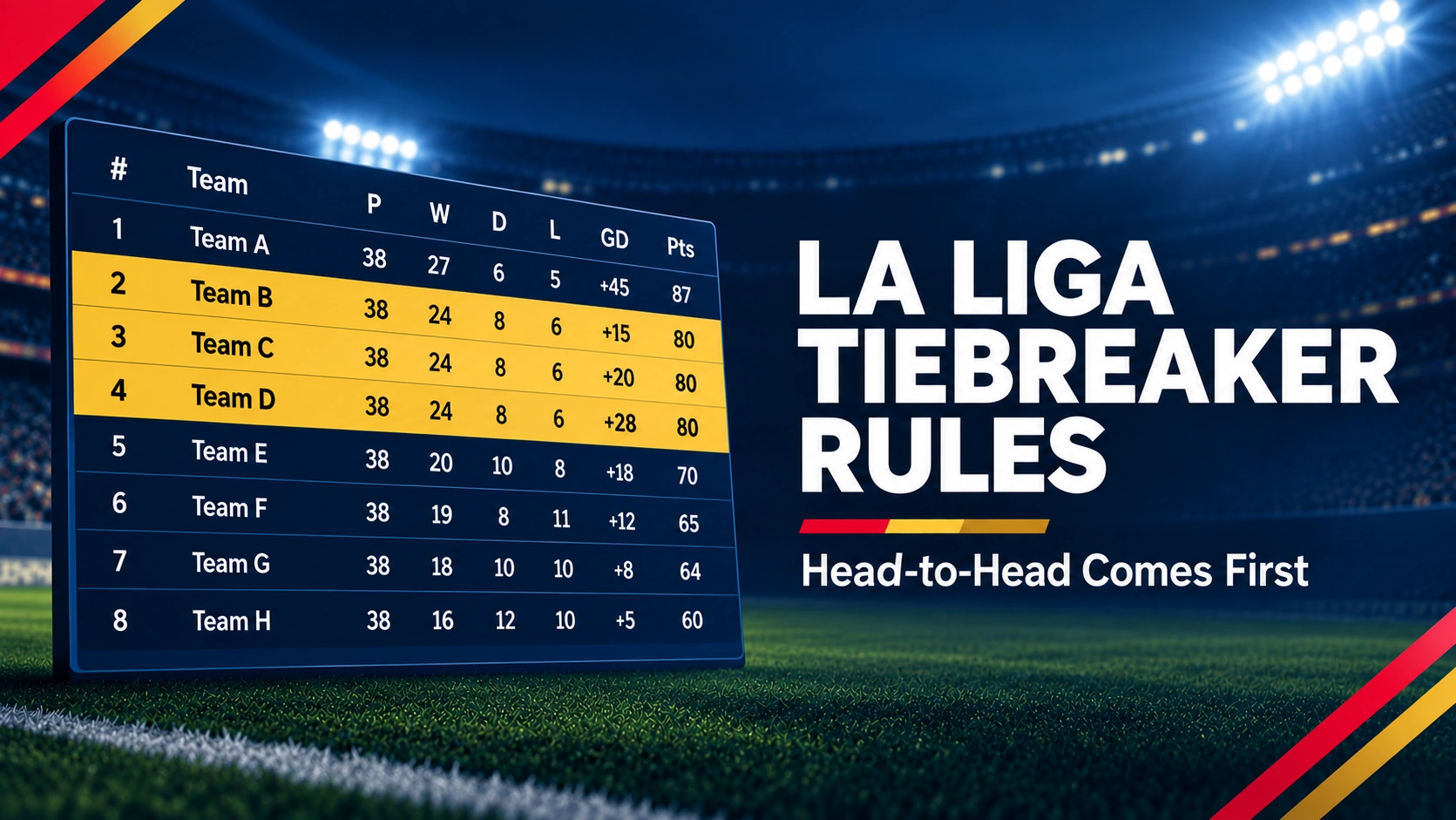
Two teams finish level on points. One has a far better goal difference. Most fans would assume that team finishes higher. In Spain, that assumption can be completely wrong.
La Liga tiebreaker rules put head-to-head results first. The two games between the tied clubs matter more than their other 36 fixtures. It’s a rule that has decided titles, European places and relegation battles. This guide breaks down how it works, why Spain does it differently, and how to read the Spanish table like a local.
What Is the First Tiebreaker in La Liga?
The first tiebreaker in La Liga is head-to-head points between the tied teams. Goal difference across the whole season only comes in later.
So if two clubs finish level, the league looks at their two meetings first. Whoever collected more points in those games finishes higher. That’s the heart of the La Liga head to head rule. Everything else is a backup plan. The order is set out in the competition regulations published by LaLiga and the Royal Spanish Football Federation.
La Liga Tiebreaker Rules Explained Step by Step
The order is simple once it’s laid out. Here’s how ties are broken in La Liga, one stage at a time.
Two Teams Level: The Head-to-Head Order
When two clubs are tied, the head-to-head results are used first. These are the games the tied clubs played against each other, with no away goals rule applied.
The steps run like this:
- Head-to-head points. The club with more points from the two meetings goes higher.
- Head-to-head goal difference. If the points are equal, the aggregate score between them decides it.
A home win and an away draw gives one side 4 points to 1. That settles it immediately. A win each means the aggregate score takes over. Wikipedia’s La Liga page sets out the same sequence in full.
When Goal Difference Finally Comes In
The La Liga goal difference rule only kicks in if head-to-head can’t separate the teams. At that point, overall goal difference is used, followed by total goals scored.
This is the big contrast with England. In the Premier League, overall goal difference is the first thing checked. In Spain, it waits in line.
Fair Play as the Last Resort
Occasionally, clubs are still level after all of that. The final step is the fair play ranking, which is based on disciplinary records. In practice, it almost never gets this far.
Quick Checklist: La Liga Tiebreaker Rules at a Glance
| Order | Two teams tied | Three or more teams tied |
|---|---|---|
| 1 | Head-to-head points | Mini-league points |
| 2 | Head-to-head goal difference | Mini-league goal difference |
| 3 | Overall goal difference | Overall goal difference |
| 4 | Overall goals scored | Overall goals scored |
| 5 | Fair play ranking | Fair play ranking |
What Happens If Teams Are Level on Points in La Liga Mid-Season?
Mid-season, overall goal difference is often used first, because the head-to-head games haven’t both been played yet.
This catches a lot of fans out. If the two-legged games between the tied clubs haven’t been completed, total goal difference and goals scored decide the order instead.
That creates a quirky moment in the season. Two teams can sit level on points in the table for months. Then they play their second meeting, and the order suddenly flips. Nothing changed in the points column. The La Liga standings rules simply switched to head-to-head once both games were done.
It’s worth remembering whenever a table looks “wrong” in spring. Usually, it’s just this rule doing its job.
La Liga Tiebreaker for Three Teams: The Mini-League
Things get more interesting when three or more clubs finish level. In that case, the tie is broken using only the games those clubs played against each other, starting with head-to-head points and then head-to-head goal difference.
Think of it as a small league inside the big one. Every other result disappears for a moment. Only the matches between the tied teams count.
A Worked Example of the La Liga Mini League Tiebreaker
Imagine Team A, Team B and Team C all finish on 60 points. Here are their six meetings:
- Team A beat Team B 2–0, then drew 1–1 away.
- Team B beat Team C 3–1, then lost 1–0 away.
- Team C beat Team A 2–0, then lost 1–0 away.
Now build the mini-league table:
| Team | Mini-league points |
|---|---|
| Team A | 7 |
| Team C | 6 |
| Team B | 4 |
Team A finishes top of the three. It doesn’t matter if Team B had the best goal difference in the whole division. In this La Liga tiebreaker, only those six games count.
If the mini-league points were also level, goal difference within those games would come next. Only then would the league look at the full season.
The Title Head-to-Head Decided: Real Madrid vs Barcelona, 2006–07
No example explains the Spanish league tiebreaker better than this one.
Real Madrid and Barcelona both finished the 2006–07 season on 76 points. Barcelona’s goal difference was +45, while Madrid’s was just +26. Under Premier League logic, Barcelona would have been champions comfortably.
Instead, the trophy went to Madrid. Madrid had won 2–0 at home and drawn 3–3 at the Camp Nou. That 4 points to 1 head-to-head edge was enough. Madrid won the title thanks to a superior head-to-head record against runners-up Barcelona.
The gap in overall numbers was striking. Madrid had scored 12 fewer goals and conceded seven more than Barcelona. Yet the two Clásicos mattered more than everything else combined.
The rule matters lower down too. In the second tier, Girona edged Oviedo for a 2022 play-off place on head-to-head points, after a 2–1 win and a 0–0 draw. Girona went on to win promotion. Fallen giants such as Deportivo La Coruña, Málaga and Racing Santander know how much those margins matter.
Why Spain Uses Head-to-Head First
This is where La Liga head to head vs goal difference becomes a genuine debate. Both systems have strong arguments.
The Case for Head-to-Head
Supporters of the Spanish approach like its simple logic. If two teams are equal on points, the fairest judge is how they did against each other. It rewards winning the direct battles between rivals.
It also stops a team from padding its numbers against weaker opponents. A 6–0 win over a struggling side doesn’t outweigh losing twice to a direct rival. Many fans feel that’s the more honest measure of who was better.
The Case Against It
Critics say two games shouldn’t outweigh 36 others. Goal difference reflects the full season’s work. Head-to-head can hinge on one lucky deflection or a single red card.
There’s also the mid-season confusion mentioned earlier. Tables can flip with no change in points. That can feel odd to fans used to a simpler system.
Neither side is objectively right. It comes down to what a league values most: direct contests or the full body of work.
La Liga vs Premier League Tiebreaker: How Other Leagues Compare
The La Liga vs Premier League tiebreaker difference is the one most fans notice first.
| League | First tiebreaker | Where head-to-head fits |
|---|---|---|
| La Liga | Head-to-head points | First |
| Premier League | Overall goal difference | After goals scored |
| Bundesliga | Overall goal difference | Later in the order |
The split exists across football more broadly: FIFA competitions tend to use goal difference first, while UEFA and AFC competitions have favoured head-to-head points. The Bundesliga sits firmly in the goal difference camp, while Serie A has its own head-to-head tradition.
The new Champions League league phase is a different case again. Most teams never meet each other, so head-to-head can’t really work there. GoalsCorner’s guide to the Champions League league phase explains how that format ranks teams.
Helpful Tips for Reading the La Liga Standings
A few habits make the Spanish table much easier to follow:
- Check whether both meetings are done. If not, goal difference is still ordering tied teams.
- Watch the second meeting closely. Late-season games between rivals can carry double weight.
- Note the aggregate score. When head-to-head points are level, the combined score decides it.
- Look at mini-leagues in tight races. Three-way ties at the bottom are more common than people expect.
- Don’t trust goal difference alone. A bigger goal difference guarantees nothing in Spain.
These La Liga points tie rules turn a lot of routine fixtures into mini finals. That’s part of the league’s drama. Promotion races work the same way in Spain, though the Championship and Primeira Liga each have their own systems.
Frequently Asked Questions
Does La Liga use goal difference or head-to-head?
La Liga uses head-to-head first. Overall goal difference is only used if head-to-head can’t split the teams, or if the tied clubs haven’t played each other twice yet.
Do away goals count in La Liga head-to-head?
No. Only the aggregate score between the two clubs counts. A 2–1 home win and a 1–0 away loss is simply 2–2 on aggregate.
Has a La Liga title ever been decided by head-to-head?
Yes. The 2006–07 title went to Real Madrid over Barcelona on head-to-head, despite Barcelona’s much better goal difference.
What happens if teams are still tied after head-to-head?
Overall goal difference is used next, then total goals scored. If clubs are still level after that, the fair play ranking decides it.
Is La Liga’s tiebreaker different from the Premier League’s?
Yes, it’s almost the reverse. The Premier League checks overall goal difference first. La Liga checks head-to-head results first.
Do fair play points matter in La Liga?
Only as a last resort. Fair play comes in after every other tiebreaker has failed, which is extremely rare.
Final Word
Spain’s system asks one simple question: who won the games that mattered between the tied teams? That’s why a club can top the goal difference charts and still finish second. It’s why late-season meetings between rivals carry so much weight. And it’s why a table can change order without a single point moving.
Once fans understand La Liga tiebreaker rules, the Spanish table starts to make a lot more sense.
Want to follow every twist in the title race and relegation fight? Head to the GoalsCorner La Liga hub for the latest coverage, or browse all GoalsCorner guides for more explainers like this one.