
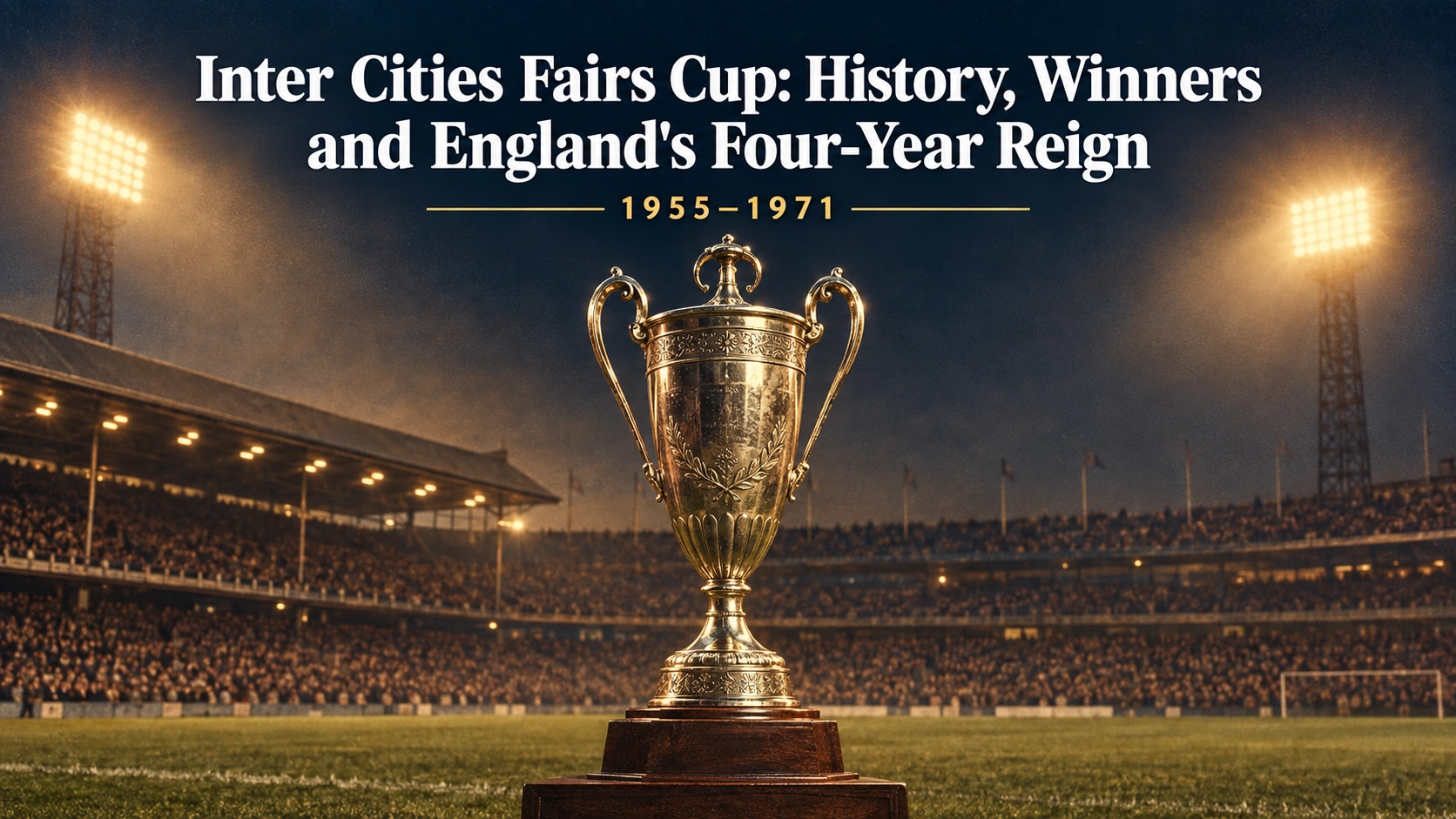
Before the Europa League and before the UEFA Cup, Europe had a stranger and slower tournament. The Inter Cities Fairs Cup ran from 1955 to 1971. It began as a sideshow to international trade fairs. It ended as one of the toughest trophies on the continent.
British fans remember it for one reason above all. English clubs won the last four editions in a row. Leeds United, Newcastle United and Arsenal all lifted the trophy between 1968 and 1971.
This guide covers the full story: the odd origins, every final, England’s golden run, and the debate over whether it counts as a real European honour.
What Was the Inter Cities Fairs Cup?
The Inter Cities Fairs Cup was a European club football competition that ran from 1955 to 1971, and the UEFA Cup (now the Europa League) replaced it.
The tournament was not organised by UEFA. An independent committee ran it. Its original purpose was to promote cities that hosted international trade fairs.
Over 16 years, it grew from a small invitational event into a major competition. By the late 1960s, it often featured stronger teams than the European Cup’s early rounds. Thirteen finals were played, plus one famous play-off for the trophy itself. You can find a detailed overview on Wikipedia’s Inter-Cities Fairs Cup page.
Fairs Cup History: Football Built Around Trade Fairs
The idea came from three powerful football administrators. Ernst Thommen of Switzerland, Ottorino Barassi of Italy and England’s Stanley Rous launched it in 1955. Rous later became FIFA president.
Their concept was simple. Cities with major trade fairs would send a team. Football would bring visitors, headlines and goodwill to those events.
City Teams, Not Clubs
Early editions were not club competitions at all. Some cities entered combined representative sides. London sent a “London XI” made up of players from several clubs in the capital.
Other cities simply sent their leading club. Barcelona’s entry, for example, was essentially the Barcelona club side.
A Three-Year First Tournament
The first edition was remarkably slow. It started in 1955 and finished in 1958. Organisers wanted matches to coincide with trade fairs, so fixtures were spread across years.
The second edition also ran over two seasons, from 1958 to 1960. Only from 1960–61 did the tournament settle into a normal yearly format.
How the Competition Worked
The rules changed as the tournament grew. By the 1960s, it looked much more like a modern European competition.
Entry Rules and the “One Club Per City” Rule
Entry still depended on cities, not league positions alone. Each city could send just one club. This rule shaped English football history.
In 1968–69, Newcastle had finished only tenth in the First Division, then the top tier of the English football pyramid. Yet they qualified for Europe. Several clubs above them shared cities with rivals who had already taken the city’s place. Newcastle took full advantage.
Two-Legged Ties and Finals
Most rounds were played over two legs, home and away. Finals were usually two-legged too. The exceptions came in 1964 and 1965, when single-match finals were played.
Level ties were first settled by play-off matches. Later, the away goals rule decided close contests. That rule would prove decisive in the final edition. Modern football still leans on similar tie-breaking tools, as our Premier League tiebreaker rules guide explains.
Inter Cities Fairs Cup Winners List: Every Final
This is the section most readers want. Here is the full inter cities fairs cup winners list, with every final result. For match-by-match detail, the RSSSF archive is the most trusted statistical source.
| Season | Winner | Runner-up | Final result |
|---|---|---|---|
| 1955–58 | Barcelona | London XI | 8–2 agg (2–2, 6–0) |
| 1958–60 | Barcelona | Birmingham City | 4–1 agg (0–0, 4–1) |
| 1960–61 | Roma | Birmingham City | 4–2 agg (2–2, 2–0) |
| 1961–62 | Valencia | Barcelona | 7–3 agg (6–2, 1–1) |
| 1962–63 | Valencia | Dinamo Zagreb | 4–1 agg (2–1, 2–0) |
| 1963–64 | Real Zaragoza | Valencia | 2–1 (single match) |
| 1964–65 | Ferencváros | Juventus | 1–0 (single match) |
| 1965–66 | Barcelona | Real Zaragoza | 4–3 agg (0–1, 4–2 aet) |
| 1966–67 | Dinamo Zagreb | Leeds United | 2–0 agg (2–0, 0–0) |
| 1967–68 | Leeds United | Ferencváros | 1–0 agg (1–0, 0–0) |
| 1968–69 | Newcastle United | Újpest | 6–2 agg (3–0, 3–2) |
| 1969–70 | Arsenal | Anderlecht | 4–3 agg (1–3, 3–0) |
| 1970–71 | Leeds United | Juventus | 3–3 agg, away goals (2–2, 1–1) |
Fairs Cup Winners by Club
Barcelona are the most successful side, with three titles. Valencia and Leeds United won two each. Seven other clubs won once.
Spain dominated the early years. England dominated the end. Few competitions have such a clear split between eras. Spanish football still does things its own way today, as our La Liga tiebreaker rules guide shows.
England’s Four-Year Reign (1968–1971)
This run is the heart of the story. From 1968 to 1971, no foreign club could stop the English. Three different clubs won the final four editions.
Leeds United 1968: Revie’s First European Prize
Don Revie’s Leeds had lost the 1967 final. They came back hungrier. Their run included a 16–0 aggregate thrashing of Spora Luxembourg.
Leeds then beat Scottish sides Hibernian, Rangers and Dundee. In the final, they met Ferencváros of Hungary. Mick Jones scored the only goal at Elland Road.
The second leg in Budapest ended 0–0. Leeds defended superbly under heavy pressure. Oddly, the final was played in August and September 1968, so Leeds won a 1967–68 trophy at the start of the next season.
Newcastle Fairs Cup 1969: Moncur’s Night of Glory
The Newcastle fairs cup 1969 story is pure romance. Joe Harvey’s side were European newcomers. They only entered thanks to the “one club per city” rule.
Newcastle beat Feyenoord, Sporting Lisbon, Real Zaragoza and Vitória Setúbal. They then knocked out Rangers in a tense semi-final. Crowd trouble marred the second leg at St James’ Park.
In the final, they faced a gifted Újpest side. Captain Bobby Moncur, a defender who rarely scored, netted twice in a 3–0 first-leg win. Jim Scott added the third.
In Budapest, Newcastle trailed 2–0 at half-time. Harvey reportedly told his players to simply score one goal. Moncur, Benny Arentoft and Alan Foggon scored after the break. Newcastle won 3–2 on the night. The 1969 Inter-Cities Fairs Cup final remains a treasured chapter of club history.
For decades, this was the club’s last major trophy. Fans waited 56 years until the 2025 League Cup final win over Liverpool at Wembley. That long wait keeps the 1969 story alive on Tyneside.
Arsenal 1970: The Comeback Against Anderlecht
Arsenal had not won a trophy since 1953. Bertie Mee’s side badly needed a breakthrough. Their semi-final was a statement: a 3–0 home win over an emerging Ajax.
The final looked lost early. Anderlecht led 3–0 in Brussels. Then substitute Ray Kennedy headed a late away goal. That single goal changed everything.
At a packed Highbury, Eddie Kelly, John Radford and Jon Sammels scored. Arsenal won 3–0 on the night and 4–3 on aggregate. Frank McLintock lifted the trophy. A year later, Arsenal won the league and FA Cup double. The 1970 final is still one of Highbury’s great nights.
Leeds Fairs Cup Glory Again in 1971
The final edition gave Leeds their second title. They beat Liverpool in the semi-final, with Billy Bremner scoring at Anfield.
The final against Juventus was chaotic. The first leg in Turin was abandoned because of a waterlogged pitch. The replayed match finished 2–2, with Paul Madeley and Mick Bates scoring.
At Elland Road, Allan Clarke scored in a 1–1 draw. Leeds won on away goals, as the 1971 final record shows. It completed England’s four-year reign in style.
Revie’s side set a standard later Leeds heroes tried to match. Gordon Strachan, for example, captained the club to the 1992 league title.
The Near-Misses
English football’s Fairs Cup record was not all glory. Several British sides came agonisingly close.
Birmingham City’s Two Finals
Birmingham City reached two finals in a row. Many modern fans are surprised by this. They lost to Barcelona in the 1958–60 final and to Roma in 1960–61.
Birmingham were the first English club to reach a European club final. That remains one of the club’s proudest facts.
The London XI
The first final featured a London XI. It drew 2–2 with Barcelona at Stamford Bridge. The second leg in Barcelona ended in a heavy 6–0 defeat.
Leeds Lose the 1967 Final
Leeds also know heartbreak in this competition. Dinamo Zagreb beat them 2–0 in Zagreb. The return leg at Elland Road finished goalless. That defeat fuelled Revie’s side for the next decade.
The 1971 Trophy Play-Off
After the final edition, a question remained. Who should keep the trophy permanently?
Organisers arranged a one-off match between the first winners and the most successful clubs. Barcelona, with three titles, faced Leeds, the last champions and double winners.
The play-off took place at the Camp Nou in September 1971. Barcelona won 2–1. They kept the original trophy for good. It still sits in the club’s museum today.
Is the Fairs Cup a UEFA Trophy?
No. UEFA does not officially recognise the Fairs Cup as one of its competitions. The tournament was run by its own committee, not UEFA.
So, is the fairs cup a uefa trophy? Technically, it is not. Its winners do not appear in UEFA’s official European records.
However, UEFA took over the format in 1971 and created the UEFA Cup. Many historians view the Fairs Cup as its direct forerunner. Clubs like Barcelona, Valencia, Leeds and Newcastle still list it proudly among their honours.
This matters for debates about clubs’ European records. It affects official trophy counts, not how fans feel about the victories.
From Fairs Cup to Europa League
The Fairs Cup did not disappear. It evolved. In 1971–72, UEFA launched the UEFA Cup using a similar format.
Tottenham won the first UEFA Cup final that season, beating Wolves. The English success simply carried on.
The UEFA Cup was rebranded as the Europa League in 2009. In 2021, UEFA added the Conference League as a third tier. UEFA’s own Europa League history pages trace the story from 1971 onwards. Every modern winner owes something to those early trade fair matches.
European football has kept changing since then. All three UEFA club competitions now open with a single league table instead of groups.
Want to see how today’s format works? Read our Champions League league phase explained guide for the modern story.
Helpful Tips for Football History Fans
- Check aggregate scores carefully. Several finals were settled over two legs, so a single score can mislead.
- Watch for season labels. Some finals were played months after the season “ended”.
- Use trusted archives. RSSSF and official club histories are the best places to verify results.
- Visit the clubs’ museums. Barcelona’s museum holds the original trophy.
Frequently Asked Questions
Who won the Fairs Cup the most times?
Barcelona won the Fairs Cup the most times, with three titles (1958, 1960 and 1966). They also won the 1971 play-off to keep the trophy.
Did Newcastle win the Fairs Cup?
Yes, Newcastle United won the Fairs Cup in 1969. They beat Újpest 6–2 on aggregate. It was their last major trophy until the 2025 League Cup.
Is the Fairs Cup the same as the UEFA Cup?
No, but the UEFA Cup replaced it in 1971. UEFA kept a similar format, so most historians treat the Fairs Cup as its predecessor.
Which English clubs won the Fairs Cup?
Leeds United (1968 and 1971), Newcastle United (1969) and Arsenal (1970) won the Fairs Cup. Together they claimed the last four titles.
When was the last Fairs Cup final?
The last Fairs Cup final was played in 1971 between Leeds United and Juventus. Leeds won on away goals after a 3–3 aggregate draw.
Final Thoughts
The Fairs Cup started as a promotional idea for trade fairs. It became something much bigger. It gave Birmingham City a European final, Newcastle a legendary night in Budapest, and Arsenal the springboard to a double.
Most of all, it gave English football four straight fairs cup winners. That run still sparks pride across Leeds, Tyneside and north London. The Inter Cities Fairs Cup may sit outside UEFA’s official records, but its history still holds a firm place in European football.
Enjoyed this story? Share it with your club’s supporters’ forum and tell us your favourite Fairs Cup memory. For more tournament history, explore our ultimate 2026 FIFA World Cup guide.