

In theory, a village side playing on a sloping council pitch could one day face Liverpool at Anfield. That is the magic of the English football pyramid. Very few clubs ever make the full journey, but the path is real, and every league sits on it somewhere.
What Is the English Football Pyramid?
The English football pyramid is a system of connected leagues, linked by promotion and relegation, that runs from the Premier League down to local amateur football. Win your division and you can move up a level. Finish near the bottom and you drop down.
The top four levels are professional. Below them sits non-league football, which the FA organises from Step 1 to Step 6. Regional feeder leagues form Step 7, the eleventh level of the game.
The structure gets wider as it goes down. The Premier League has 20 clubs. By Step 6, there are hundreds of clubs spread across dozens of divisions.
Fans, players and club officials all ask the same questions. What level is my team at? Why didn’t the champions go up? This guide answers them, level by level.
Quick facts:
- Around 11 connected levels run from the Premier League to Step 7.
- For 2026-27, the FA placed 996 clubs across 48 divisions and 19 leagues at Steps 1 to 6 (The FA).
- The 92 Premier League and EFL clubs sit above all of them.
The English Football Pyramid Diagram: Every Level at a Glance
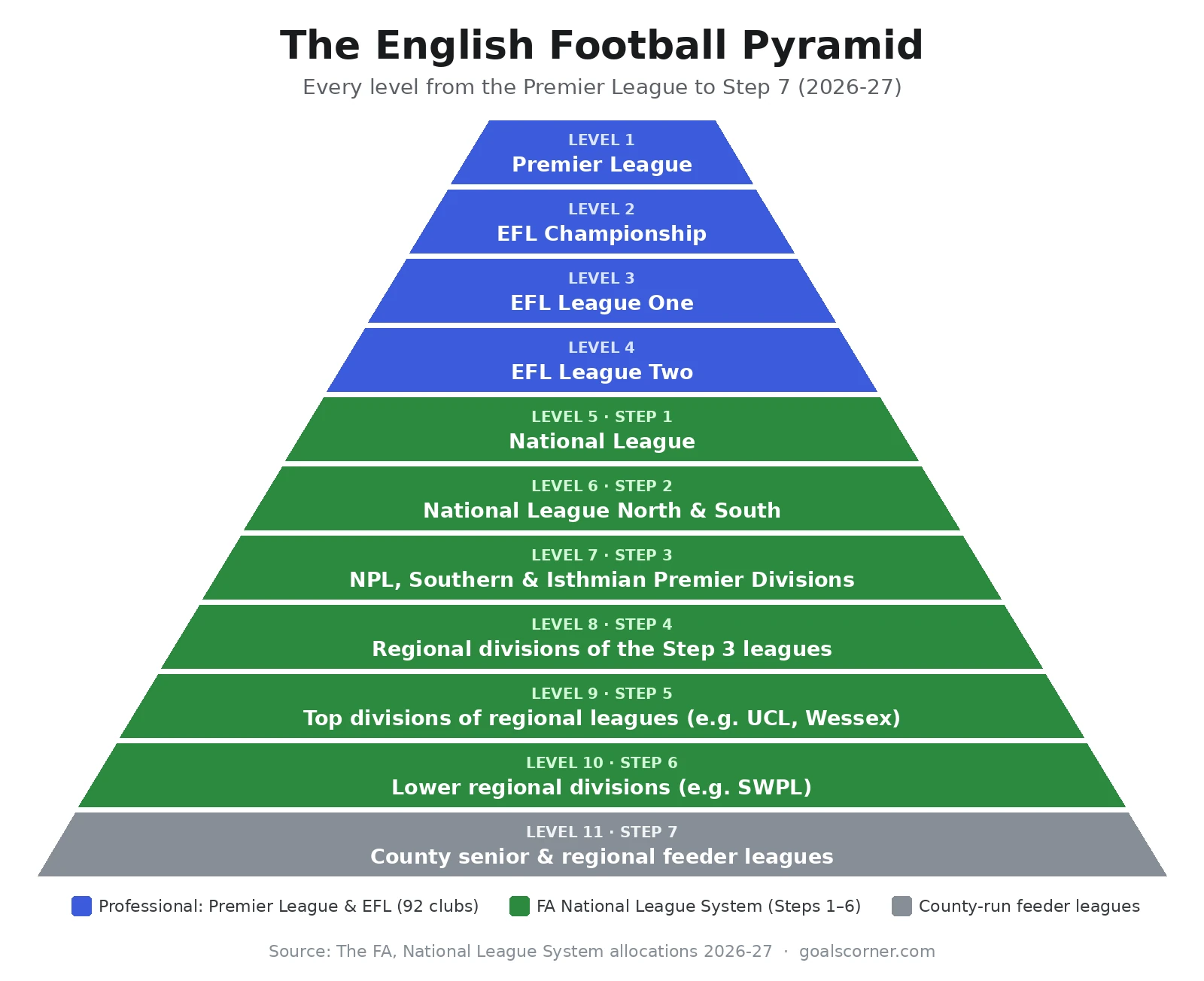
The pyramid widens as it drops. One Premier League division sits on top, while Steps 5 and 6 hold dozens of regional divisions. Step 7 leagues are run with County FAs and sit just below the FA-run steps.
Levels 1–4: The Professional Leagues
The top four levels hold the 92 full-time clubs most fans know. The Premier League runs Level 1. The English Football League (EFL) runs Levels 2 to 4.
Level 1: The Premier League
Twenty clubs play each other home and away over 38 games. The bottom three drop into the Championship. Tight finishes are settled by set rules, which our guide to Premier League tiebreaker rules breaks down.
The top clubs also chase European places. For the latest on the big names, see our previews of Liverpool’s 2026-27 season and Manchester United’s 2026-27 season.
Level 2: The Championship
The Championship has 24 clubs and a 46-game season. The top two go up automatically. Clubs finishing third to sixth enter the play-offs for the final promotion spot.
Level 3: League One
League One follows the same promotion pattern: two automatic places plus a play-off. Four clubs are relegated to League Two.
Level 4: League Two
League Two sends three clubs up automatically, with fourth to seventh in the play-offs. The bottom two drop out of the EFL entirely. They land in the National League, the top of the non league pyramid.
That trapdoor is real. Barrow and Harrogate Town dropped out of League Two in 2026. Rochdale climbed back the other way through the National League play-off final (The Non-League Football Paper).
The National League System: Steps 1–7 Explained
Below League Two, the levels are called “steps”. The national league system (NLS) covers Steps 1 to 6 and is run by the FA. Since 2020-21, Step 7 has been made up of regional feeder leagues overseen by County FAs (The National League).
Think of it as a funnel in reverse. Each step has more divisions than the one above, so clubs are grouped by region to cut travel.
Step 1: The National League
Step 1 is a single national division of 24 clubs. It sits directly below League Two, at Level 5 overall. Many clubs here are full-time, and several are former EFL sides.
The champions go straight up to League Two. A play-off decides the second promotion place.
Step 2: National League North and South
Step 2 splits into two regional divisions of 24 clubs each. The split keeps travel manageable for part-time players. Worthing (champions) and Hornchurch (play-off winners) went up from the South in 2026.
Step 3: The Premier Divisions
Step 3 has four divisions, run by three bodies often called the “Trident Leagues”:
- Northern Premier League Premier Division
- Southern League Premier Central and Premier South
- Isthmian League Premier Division
Champions and play-off winners move up to Step 2. The FA decides which Step 2 division they join, based mainly on geography.
Step 4: The Regional Divisions
Step 4 holds eight regional divisions below those premier divisions. The Northern Premier League runs East, Midlands and West. The Southern League runs Central and South. The Isthmian League runs North, South Central and South East.
Step 5: The Top Divisions of Regional Leagues
Step 5 football is where the pyramid turns truly local. It is Level 9 overall, made up of the top divisions of regional leagues. Examples include the United Counties League, the Wessex League and the North West Counties League (still widely known as the Hallmark Security League).
Most Step 5 clubs are semi-professional at best. Players often get travel expenses rather than a wage. Yet this is where the FA Vase gives village sides a shot at Wembley.
Step 6: The Divisions Below
Step 6 sits at Level 10. It covers the lower divisions of most Step 5 leagues, plus Step 6-only leagues like the South West Peninsula League, which feeds the Western League. The FA can now reprieve Step 6 clubs on geographical grounds when a division would fall below 18 teams.
Step 7: County Senior Leagues
Step 7 is Level 11. These are the top county leagues, such as the Essex Olympian League or the Cambridgeshire County League. They feed clubs into Step 6, provided grounds meet the grading rules.
What Step Is My League? Where Popular Leagues Fit
One question comes up again and again: what step is my local league? The table below maps some of the leagues Goalscorner covers to their place in the 2026-27 structure.
| League | Division | Step | Overall level | Guide |
|---|---|---|---|---|
| United Counties League | Premier North and Premier South | 5 | 9 | [Link to UCL guide] |
| North West Counties League (Hallmark Security League) | Premier Division | 5 | 9 | [Link to NWCFL guide] |
| Wessex League | Premier Division | 5 | 9 | [Link to Wessex guide] |
| South West Peninsula League | Premier East and Premier West | 6 | 10 | [Link to SWPL guide] |
| Suffolk & Ipswich League (SIL) | Senior Division | 7 | 11 | [Link to SIL guide] |
| Essex Olympian League | Premier Division | 7 | 11 | [Link to guide] |
| Cambridgeshire County League | Premier Division | 7 | 11 | [Link to guide] |
| Bedfordshire County League | Premier Division | 7 | 11 | [Link to guide] |
| Northern Football Alliance | Premier Division | 7 | 11 | [Link to guide] |
Placements follow the FA’s Steps 5/6 allocations for 2026-27. Leagues can move between steps, so check the FA’s list each summer.
Helpful tip: A league’s step applies to its top division only. A club in a league’s lower divisions sits one or more steps further down.
Below Step 7 and Outside the Pyramid
Not every league connects to the Premier League. Below Step 7, county leagues run their own lower divisions. Promotion from those can still lead up the ladder, one level at a time.
Other leagues sit outside the system altogether. There are three main groups.
Sunday Leagues
Sunday leagues are the heartbeat of grassroots football. Thousands of teams play on Sunday mornings for fun, fitness and bragging rights. They have their own divisions, but they do not feed into the Saturday pyramid.
That is simply because the pyramid plays on Saturdays. A Sunday side wanting to climb would need to switch days and join a Step 7 feeder league. Our [Grimsby Sunday League guide] shows how a local Sunday set-up works.
Youth Leagues
Youth football runs in age groups, not steps. Clubs build pathways from under-7s upward, but youth teams never earn promotion into the senior pyramid.
Amateur Football Alliance Leagues
The Amateur Football Alliance (AFA) acts like a County FA for a group of mostly London-based amateur clubs. Many started as old boys’ sides of schools, banks and universities. Its leagues keep a proud amateur ethos and do not chase promotion.
The Amateur Football Combination is one of the biggest. Our guide explains its divisions and history.
Why Do Some Leagues Stay Outside?
The reasons are usually practical. Joining the system brings ground grading rules, fees and longer travel. Plenty of clubs prefer cheap pitches, local rivals and a relaxed Saturday or Sunday. For them, the game matters more than the climb.
How Promotion Works in Non-League Football
Winning the league is only half the job in the non league pyramid. A club must also prove its ground and paperwork are ready for the step above.
Ground Grading: The Hidden Hurdle
The FA grades every ground against a set of standards. Each step has its own grade, from Grade A at Step 1 down to Grade F at Step 6. Requirements rise as you climb, covering things like:
- Floodlights of a set strength
- Covered seating and standing areas
- A pitch barrier and proper changing rooms
- Enough turnstiles and toilets for the crowd
A club must meet the grade for the step it wants to join, by a deadline set before the season ends. Upgrades can cost tens of thousands of pounds. For a volunteer-run club, that is a huge ask.
Why Champions Sometimes Stay Down
This is the question most guides skip. A club can top the table and still miss out on promotion. The usual reasons are:
- No application. Clubs must apply for promotion in advance. Some choose not to, often for money reasons.
- Ground not up to grade. If the facilities fail inspection, the place passes to the next eligible club.
- Groundshare problems. A club without its own home must secure an approved groundshare in time.
It happens more often than people think. For 2026-27, City of Liverpool were placed at Step 7 after failing to agree a groundshare in time (NWCFL).
How Play-offs Work at Lower Steps
Play-offs give more clubs a shot at going up. At Step 3, the champions go up with the winners of a play-off between second and fifth. Lower down, formats vary by league and by season.
Every May, the FA then allocates clubs to divisions for the next season. It balances numbers and geography. Points per game decides who gets reprieved when gaps appear. For 2026-27, there were 13 reprieves at Step 5 and 20 at Step 6.
Tip for club officials: Check your County FA’s ground grading checklist early. Small fixes, like signage or rails, are cheaper when done over a summer.
The Women’s Football Pyramid
Women’s football has its own pyramid, separate from the men’s game. The Women’s Super League (WSL) sits at the top, with WSL 2 below it. Under those comes the FA Women’s National League, split into regional divisions, then county and regional leagues.
It follows the same idea of promotion and relegation, with licensing rules at the top levels. [Link to future women’s pyramid guide]
What About Scotland and Wales?
Scotland and Wales run their own separate pyramids.
Scotland has four SPFL divisions: the Premiership, Championship, League One and League Two (SPFL). Below them, the Highland League and Lowland League form the fifth tier. The East of Scotland League sits beneath the Lowland League, and many former junior clubs have now joined the pyramid. [Link to future Lowland League, East of Scotland League and junior football guides]
For a slice of Scottish football history, read our profile of Gordon Strachan.
Wales has the Cymru Premier at the top, with Cymru North and Cymru South below it (FAW). A handful of Welsh clubs, including Cardiff City, Swansea City and Wrexham, play in the English system instead. [Link to future Welsh pyramid guide]
Frequently Asked Questions
What step is the National League?
The National League is Step 1 of the National League System. It is the fifth level of English football overall, directly below League Two.
How many levels are in English football?
The English football pyramid has 11 levels from the Premier League to Step 7. County leagues add further divisions below that, so the full count depends on the area.
What is Step 5 football?
Step 5 football is the ninth level of the game. It is made up of the top divisions of regional leagues, such as the United Counties League and the Wessex League. Clubs here are mostly amateur or semi-professional.
Can a Sunday league team get promoted to the Premier League?
Not directly. Sunday leagues sit outside the Saturday pyramid. A Sunday team would first need to switch to Saturdays and join a Step 7 feeder league. From there, it would need around ten promotions and a fully graded stadium.
How do non-league clubs get promoted?
Non-league clubs get promoted by finishing top or winning a play-off, then passing ground grading. They must also apply for promotion by the FA’s deadline. The FA confirms final placements each May.
Final Whistle: The Football Pyramid Explained in One Line
With the football pyramid explained, the big idea is simple. Every connected league offers a route upward, as long as clubs win and invest in their grounds. The journey from Step 7 to the Premier League is long, but it is open.
Ready to find out more about your local league? Browse our non-league guides and see exactly where your club stands. Got a question we missed? Drop it in the comments, and we will add it to this guide.
From packed Premier League stadiums to muddy Step 7 pitches, the English football pyramid ties the whole game together.