

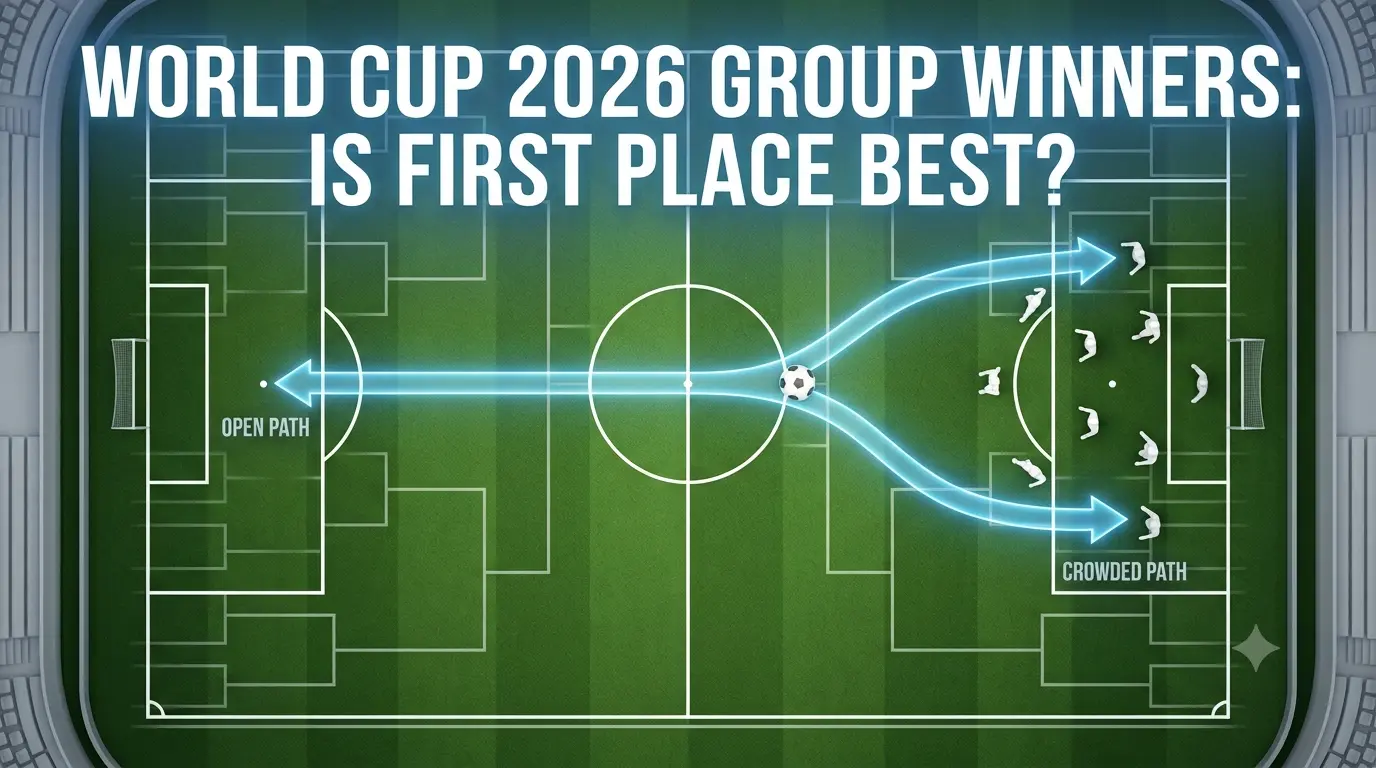
A manager stands on the touchline during the final group match. The team already leads. A decision looms. Should they push for the win, or rest tired legs for second place? In past tournaments, the answer was easy. Win the group, every time. But the World Cup 2026 group winners face a stranger reality. Finishing first is supposed to be the reward. In this expanded tournament, it is not always the smartest outcome.
This guide breaks down when topping a group truly helps, and when it quietly hurts.
Do World Cup 2026 Group Winners Always Get an Easier Opponent?
No. Only eight of the twelve group winners are paired with a third-placed team. The other four must face a runner-up instead.
That single fact changes everything. Most fans assume that winning a group guarantees a softer route. The new format breaks that assumption. According to FIFA’s official tournament regulations, the winners of groups A, C, D, E, G, I, K, and L draw a third-placed side. The winners of groups B, F, H, and J draw a runner-up. A runner-up is usually the tougher test. So the reward depends heavily on which group a team happens to win.
A Quick Refresher: The 48-Team World Cup Format Explained
The 2026 edition is the first to feature 48 teams. The field splits into 12 groups of four. The top two from every group advance. Then the eight best third-placed teams join them. That adds up to 32 sides and a brand-new knockout round.
This new round of 32 format did not exist before 2026. The old 32-team setup sent only 16 teams straight to the round of 16. With more teams, FIFA needed an extra knockout step. The knockout stage runs from June 28 to the final on July 19 at MetLife Stadium. Every match is single-elimination. Level scores go to extra time, then penalties.
Helpful tip: The expanded format means 32 of 48 teams reach the knockouts. Two-thirds of the field survives the group stage.
The Rule Almost Nobody Explains Properly
Here is the detail most guides skip. The round of 32 group winners pairings are not symmetrical. Eight group winners get the lucky losers. Four group winners get a runner-up.
The table below makes the split clear.
| Group winners who face a third-placed team | Group winners who face a runner-up |
|---|---|
| Groups A, C, D, E | Group B |
| Groups G, I | Group F |
| Groups K, L | Groups H, J |
For example, the Group H winner meets the Group J runner-up. Meanwhile, the Group H runner-up plays the Group J winner. Finishing first and finishing second send a team down completely different paths. That is the core of the World Cup 2026 bracket path puzzle.
When Finishing First Genuinely Helps
The case for winning a group is still strong. Honesty matters here, so the advantages deserve credit.
First, most group winners do get an easier draw. Eight of twelve face a third-placed qualifier rather than a runner-up. That is a real draw advantage.
Second, bracket positioning improves. A group winner often lands on a friendlier side of the draw. That can shape the entire World Cup 2026 knockout bracket explained on paper.
Third, momentum and rest help. A team that wins early can rotate its squad. Resting players in a dead rubber keeps stars fresh for the knockout stage.
When Winning the Group Backfires
Now for the twist. The question “do group winners get easier draw World Cup” has a surprising answer. Sometimes, no.
The Wrong-Group Problem
Four group winners draw a runner-up, not a third-placed team. A runner-up has usually performed better than a lucky loser. So those winners earn no real reward. Their group runner-up round of 32 opponent could be a heavyweight.
A Third-Placed Team Can Be a Monster
The phrase “best third-placed team” sounds harmless. It is not always. A strong nation can finish third in a brutal group. The World Cup 2026 best third-placed teams might include a fallen giant playing freely with nothing to lose.
The Bracket-Path Trap
A team can beat an easy opponent and still suffer. Winning the group might place a side among the favorites. The World Cup 2026 third place qualification system reshapes every route. An easier first match can lead to a harder second one.
The Runner-Up Swap
In paired groups, first and second place flip a team’s trajectory. The winner and runner-up swap opponents entirely. One result decides whether a side meets a champion or an underdog next.
Should a Team Ever Play for Second?
This is the question almost no one asks. Could a smart team prefer second place?
In theory, yes. If a group winner draws a feared runner-up, second place might be safer. A clever manager could weigh squad rotation against the reward.
But integrity rules complicate things. FIFA strongly discourages teams from manipulating results. Crowds, sponsors, and officials watch closely. Playing for second also carries risk. Goal difference tiebreaker swings can ruin the plan. One mistake, and a team drops out entirely.
So the idea stays mostly theoretical. Still, it shows how the new math twists old instincts.
History Says Third Place Is Not a Death Sentence
Doubters should remember recent tournaments. Finishing lower in a group has not stopped champions.
Portugal won Euro 2016 after finishing third in their group. They advanced on three draws and lifted the trophy. Ivory Coast won the 2023 Africa Cup of Nations as one of the weakest third-placed qualifiers. They even sacked their coach mid-tournament, then triumphed.
At the World Cup itself, Argentina and Italy both reached finals after surviving earlier group formats. The lesson is simple. A messy group stage rarely defines a team’s ceiling.
Fact: The 48-team field uses the same spirit as the 1986 to 1994 tournaments. Back then, the best third-placed teams also advanced.
Who Actually Benefits Among World Cup 2026 Group Winners?
The real winners depend on the live bracket. As group stage standings settle, the picture sharpens.
Teams in groups A, C, D, E, G, I, K, and L gain the most from finishing first. They unlock the softer third-placed route. Teams in groups B, F, H, and J gain far less. Their reward is a runner-up, so the incentive to chase first place shrinks. Track the live group stage standings to see how each route firms up.
This is where the 495 combinations matter. FIFA lists every possible scenario in Annex C of its regulations, and outlets like Sports Illustrated and ESPN keep updated breakdowns. A computer maps each one to prevent early rematches. That is why the official bracket shows several possible opponents at once.
This section updates as results land. Bookmark it to track who benefits after every matchday.
The Verdict
So, does finishing first help? Usually, yes. The data still favors group winners overall. They enjoy a draw advantage, better seeding, and rest.
But the answer is conditional. For teams in groups B, F, H, and J, the prize is thinner. For a few, second place is a defensible goal. The new format rewards smart planning as much as raw results. That nuance is exactly what makes the World Cup 2026 group winners debate so fascinating.
Want more sharp takes like this? Follow along through the knockout stage for fresh analysis after every round.
Frequently Asked Questions
Is it better to finish first or second in a World Cup 2026 group?
Usually first, but not always. Eight group winners get an easier third-placed opponent. The other four draw a runner-up, so second place can occasionally feel kinder.
Can a third-placed team win the 2026 World Cup?
Yes. History proves lower group finishes do not block champions. Portugal and Ivory Coast both won major titles after weak group runs. A hot team can surge through single-elimination football.
How do the eight best third-placed teams qualify?
They are ranked in one table. The order follows points, then goal difference, then goals scored. Fair play points and the FIFA World Ranking tiebreaker settle any remaining ties, as set in Article 13.
Who do World Cup 2026 group runners-up play in the round of 32?
It varies by group. Each runner-up meets either a group winner or another runner-up. The exact group runner-up round of 32 opponent depends on the final bracket.
Why does the 2026 World Cup have a round of 32?
The expanded format created it. Twelve groups now send 32 advancing teams forward. That number needed a new knockout round before the round of 16.
What is the difference between the round of 32 and the round of 16?
The round of 32 is the new first knockout step. It feeds the round of 16. Both are single-elimination, but the round of 32 is unique to the 48-team era.