

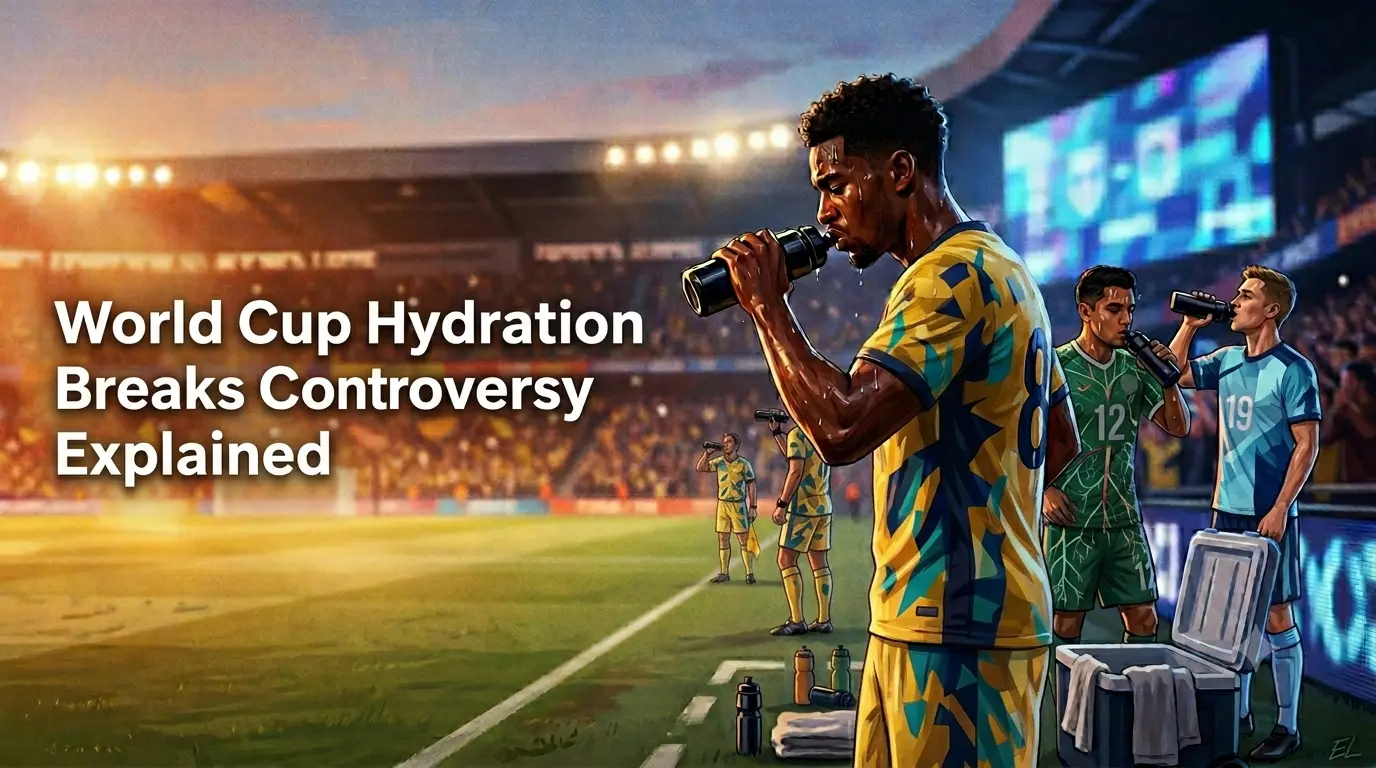
The World Cup hydration breaks controversy has become one of the loudest off-pitch debates of the 2026 tournament. Fans love the football. Yet many keep asking the same question. Are these new pauses protecting players, or padding profits? FIFA says the breaks guard health in brutal heat. Critics point to fresh advertising slots and wonder aloud. This article follows the money, weighs the science, and lets readers judge for themselves.
Why Does the World Cup 2026 Have Hydration Breaks?
The World Cup 2026 has hydration breaks to protect players from extreme heat across North America.
That is the short answer. The longer story is more interesting.
This is the first World Cup to mandate a pause in every single match. The rule covers all 104 games. It applies whether the stadium bakes at 90 degrees or sits under a cool roof. Referees stop play roughly 22 minutes into each half. Players then drink, cool down, and reset for three minutes.
Forecasters warn this could be the hottest tournament in history. Heat illness is a genuine danger for elite athletes. So on paper, the logic looks sound.
What Exactly Is the Three-Minute Hydration Break World Cup Rule?
Each three-minute hydration break World Cup stoppage works like a mini timeout.
The referee blows the whistle near the 22nd minute. Players head to the touchline for water and salts. Coaches gather their squads and talk. A second whistle restarts the action. The lost time returns through added stoppage time at the end of each half.
It feels simple. The arguments around it are anything but.
Why FIFA Introduced Hydration Breaks
Understanding why FIFA introduced hydration breaks starts with one word: welfare.
Football’s governing body frames the rule around player welfare. Athletes who sprint in heat and humidity risk exertional heat illness. This condition pushes core body temperature dangerously high. It strains the heart, muscles, and nervous system. Symptoms include cramps, dizziness, nausea, and crushing fatigue. In severe cases, heat exhaustion can tip into life-threatening heat stroke.
The warning signs are not theoretical. During the 2025 Club World Cup in the United States, players openly described feeling unwell in punishing conditions. Argentina midfielder Enzo Fernández said he felt dizzy as temperatures soared. That summer became a clear preview of the heat challenge ahead.
So the case for hydration breaks player safety is real. Few people seriously dispute that heat can harm athletes. The disagreement lives elsewhere.
The World Cup Hydration Breaks Controversy: Following the Money
Here is where the World Cup hydration breaks controversy truly heats up.
FIFA gave its broadcast partners permission to run commercials during these pauses. That single decision changed the conversation. Two short breaks across 104 matches create hundreds of fresh advertising windows. Critics did the math quickly. More stoppages mean more screen time for sponsors.
This is the heart of the hydration breaks commercial revenue debate. Welfare and money are not mutually exclusive. A rule can protect players and still generate income. Yet the timing of the advertising green light raised eyebrows worldwide.
Hydration Breaks Advertising and the Skeptics
The hydration breaks advertising angle gained a powerful voice. Netherlands captain Virgil van Dijk noticed the pattern while watching earlier games. He observed that each break seemed to flow straight into a commercial. His point was simple. The pauses doubled as ad breaks.
Once fans heard that, many could not unsee it. The phrase “follow the money” started trending for a reason.
Are Hydration Breaks Necessary in Every Match?
Hydration breaks are necessary in extreme heat, but their value drops sharply in cool, roofed venues.
That nuance fuels much of the FIFA hydration break criticism. Several matches take place inside climate-controlled stadiums. The air stays comfortable. The players stay cool. Yet the mandatory break happens anyway.
Spain coach Luis de la Fuente captured the tension neatly. Before facing Cape Verde in Atlanta, he agreed the pauses help in real heat. He also suggested they matter less inside a cooled arena. His honesty summed up a widespread feeling.
This is the core question. Are hydration breaks necessary when the weather poses no threat? Many coaches say no.
World Cup Cooling Breaks Rule: How 2026 Differs From 2014
The World Cup cooling breaks rule is not entirely new. The execution is.
FIFA first used cooling breaks at the 2014 tournament in Brazil. Those 2014 Brazil cooling breaks were optional. Officials triggered them only when the Wet Bulb Globe Temperature crossed a safety threshold. WBGT measures heat, humidity, and sun together. When conditions turned dangerous, breaks arrived near the 30th and 75th minutes.
The 2026 version flips that approach. Now the break is automatic and universal. No temperature trigger applies. Every match gets two pauses, hot or not. That shift from “when needed” to “always” is exactly what critics question.
Is FIFA Turning Football Into a Four-Quarter Sport?
Some observers worry about a quieter change to the game’s identity.
Football traditionally flows across two long halves. The new structure splits each half in two. The result resembles a four-quarter format. That rhythm feels closer to American sports than to classic football. Critics call it a slow Americanization of the world’s game.
Supporters of the flow argument raise another concern. The breaks can freeze a team’s momentum. A side building pressure suddenly stops. The match flow resets. A trailing team can regroup, adjust, and escape the storm.
Hydration Breaks as a Tactical Timeout
This momentum issue turns the pause into a tactical timeout.
Coaches use the three minutes to coach. They tweak shape, switch markers, and calm nerves. In a tight game, that window carries real weight. A well-timed instruction can swing a result. So the break stops being only about water. It becomes a strategic weapon.
Do the Breaks Actually Cool Players Down?
The science offers a mixed verdict.
Most experts agree the intention is sound. Regular hydration helps prevent the worst heat outcomes. Formalizing water breaks also brings consistency across every match. Players already grab drinks during natural stoppages. A fixed rule simply guarantees the chance.
Yet some scientists question the impact. They argue three minutes may be too short to lower core body temperature much. A brief pause helps morale and fluids. It may not dramatically cool an overheated athlete. So the breaks likely reduce risk without erasing it.
FIFA Hydration Breaks Explained: A Quick Fact Sheet
Here is the rule in plain terms, with FIFA hydration breaks explained simply:
- When: Around the 22nd minute of each half.
- How long: Three minutes per break.
- How many: Two per match, in all 104 games.
- Why: Player welfare and extreme heat protection.
- Lost time: Added back as stoppage time.
- The catch: Mandatory even in cool, roofed stadiums.
How Competitors Are Covering the Story
Major outlets have circled this debate from different angles. ESPN broke down why the breaks exist and why FIFA faced backlash. NPR focused on the health science and the dangers of heat illness. NBC framed the clash between safety goals and commercial gain. Yahoo Sports highlighted player and coach frustration over flow. OutKick traced the rule back to the 2014 Brazil precedent.
Most coverage explains the rule well. Far fewer pieces connect every thread at once. That gap is where deeper, money-focused analysis stands out.
Helpful Tips for Watching With Fresh Eyes
Want to judge the debate yourself? Try these during the next match:
- Note the clock when the referee pauses play.
- Watch whether the broadcast cuts to a commercial.
- Check the stadium type. Open-air or roofed?
- See if a struggling team improves right after the break.
These small habits reveal the rule’s real effects.
Frequently Asked Questions
Can broadcasters show ads during hydration breaks? Yes. FIFA permitted broadcast partners to run commercials during the pauses, which expanded TV advertising slots significantly.
Are hydration breaks mandatory in every match? Yes. The rule applies to all 104 matches, regardless of temperature, stadium roof, or kick-off time.
Do the lost minutes get added to stoppage time? Yes. Officials calculate the paused time and return it through added stoppage time at the end of each half.
Can coaches give tactical instructions during the break? Yes. Coaches use the three minutes to adjust tactics, making the pause function much like a timeout.
Do players and coaches support hydration breaks? Opinions split. Many back them in real heat, yet several question their need inside climate-controlled stadiums.
Final Whistle: Safety, Money, or Both?
So where does the World Cup hydration breaks controversy finally land?
The fairest answer is “both.” The heat is real, and player welfare matters deeply. No one wants to watch an athlete collapse on the pitch. At the same time, the extra advertising windows are real too. A rule can protect health and still print money.
Fans do not have to pick one story. They can hold both truths together. The breaks may shield players and boost revenue at once. That honest, two-sided view is what this debate needs.
Want more clear-eyed takes on the rules shaping World Cup 2026? Explore our tournament explainer hub and follow along all summer. Drop your verdict in the comments. Safety, money, or both?