

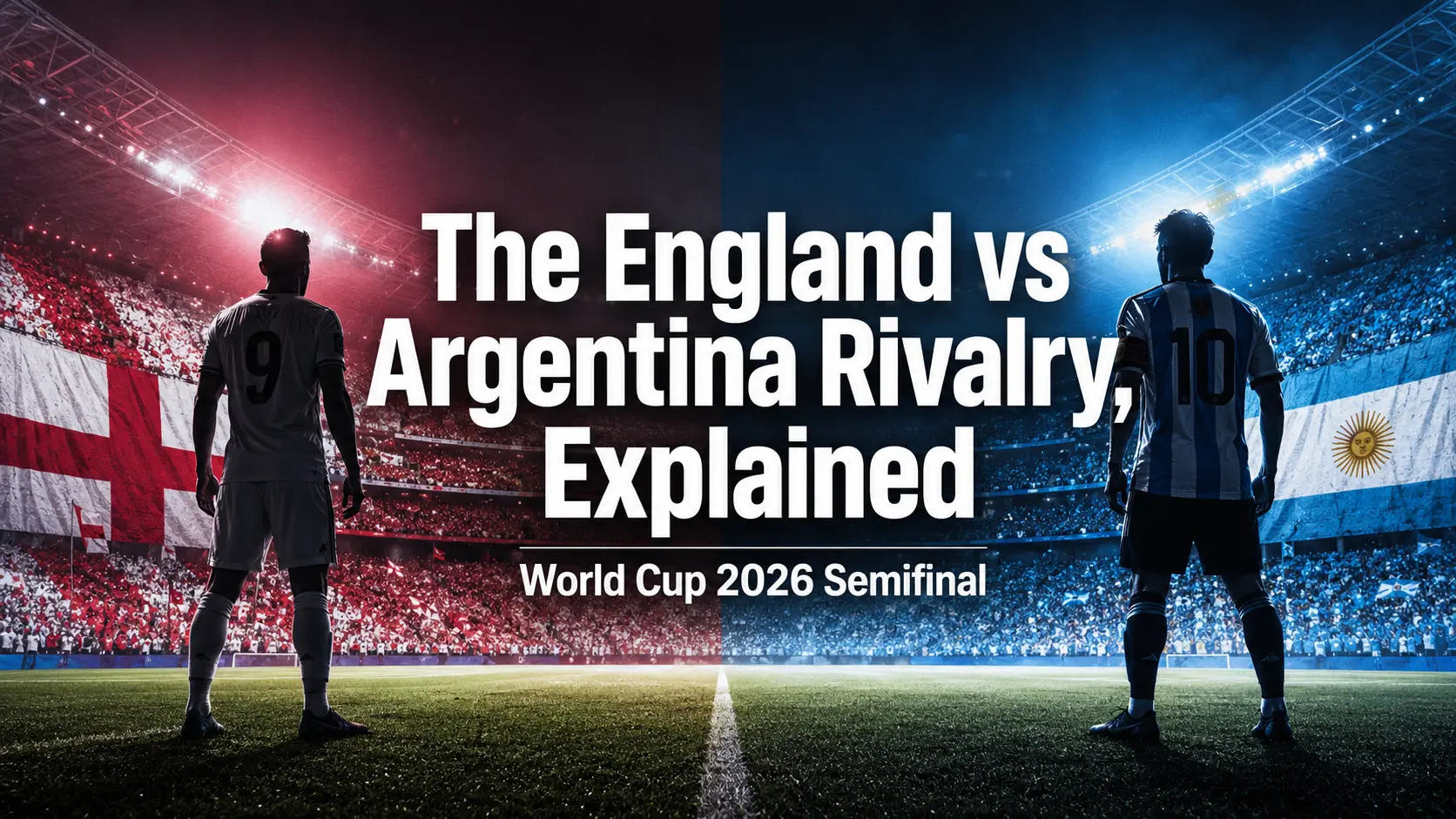
New to soccer and wondering why everyone keeps calling Wednesday’s World Cup semifinal a grudge match? The England vs Argentina rivalry is one of the fiercest in international sports. Think Yankees–Red Sox, but with world titles, national pride, and a real war in the background. On July 15, 2026, the two nations meet again in Atlanta. It will be their first clash in over 20 years. This guide walks American fans through the history, the villains, the heroes, and why this game matters so much.
Why Are England and Argentina Such Bitter Rivals?
England and Argentina are bitter rivals because of decades of controversial World Cup clashes, most famously Diego Maradona’s “Hand of God” goal in 1986, combined with the political fallout of the 1982 Falklands War.
The rivalry did not start with one single moment. It built up in layers. A bad-tempered quarterfinal in 1966 planted the seed. A real armed conflict in 1982 poured fuel on it. Then Maradona lit the match four years later. Every meeting since has carried that weight. Players feel it. Fans feel it. Even neutral viewers can sense it.
The good news for viewers? The tension almost always produces unforgettable drama.
England vs Argentina Head to Head: The Numbers
Here is the England vs Argentina head to head record at a glance. According to Opta’s historical data, the two teams have met 14 times since 1951. England have won six. Argentina have won three. Five matches ended in draws, though Argentina won one of those on a penalty shootout at the 1998 World Cup.
Wednesday’s game will be their sixth meeting at a World Cup. The previous five came in 1962, 1966, 1986, 1998, and 2002. Their last match of any kind was a wild 3-2 friendly win for England in 2005.
Quick facts for the group chat:
- Argentina are the reigning world champions after winning the 2022 title in Qatar.
- Argentina have never lost a World Cup semifinal, going a perfect five for five.
- England are chasing their first World Cup final since they won it all in 1966.
England vs Argentina World Cup History: Four Defining Chapters
Understanding the England Argentina rivalry history means understanding four matches. Each one added a new grievance or a new hero. Together, they explain why this fixture feels bigger than soccer.
1966: “Animals” at Wembley
The 1966 World Cup England Argentina quarterfinal set the tone for everything that followed. Argentina captain Antonio Rattín was sent off in a chaotic game at Wembley. He refused to leave the field for several minutes. England won 1-0 and went on to lift the trophy. Afterward, England manager Alf Ramsey reportedly described the Argentine players as “animals.” The insult never left Argentine memory. A rivalry was born.
1986: The Hand of God Goal and the Goal of the Century
The Maradona Hand of God 1986 moment remains the most infamous goal in World Cup history. In the quarterfinal at Mexico City’s Azteca Stadium, Diego Maradona punched the ball past England goalkeeper Peter Shilton. The referee missed the handball and gave the goal. Maradona later said it was scored “a little with the head of Maradona and a little with the hand of God.”
Just four minutes later, he did something even more remarkable. Maradona dribbled past half the England team from his own half and scored. That strike is now known as the Goal of the Century. Argentina won 2-1 and later won the tournament. For England fans, the Hand of God goal is a scar that has never fully healed. For Argentines, the whole match felt like justice.
1998: Beckham’s Red Card and a Teenage Wonder Goal
The 1998 round-of-16 clash in France had everything. An 18-year-old Michael Owen scored one of the great solo goals, slaloming through the Argentine defense. The Michael Owen goal 1998 announced a new English star to the world.
Then came the flashpoint. The Beckham red card 1998 changed the game. After a foul, David Beckham flicked his boot at Argentina’s Diego Simeone, who went down theatrically. The Beckham Simeone incident earned Beckham a red card. Ten-man England hung on for a 2-2 draw but lost the penalty shootout. Beckham became a national scapegoat overnight. He even received death threats back home.
2002: Redemption in Sapporo
Four years later, the script flipped. England faced Argentina in the group stage in Sapporo, Japan. Beckham, now England captain, stepped up to a penalty against the country that had tormented him. He smashed it home. England won 1-0, and Argentina crashed out of the group stage. It remains England’s last competitive win in the rivalry.
The Falklands War and Football
No explainer is complete without the political backdrop. The Falklands War England Argentina fought in 1982 lasted ten weeks. The conflict over the South Atlantic islands cost more than 900 lives. It turned a sporting rivalry into something far more personal.
The Falklands War football connection became explicit in 1986. Maradona later admitted that the Hand of God felt like symbolic revenge for the war. Relations between the two nations have improved a great deal since then. Beckham and Simeone were even photographed together, smiling, in the stands earlier this tournament. But the history still hums beneath every meeting.
Messi vs England: A First After All These Years
Here is a wild fact. Lionel Messi has never played against England. Not once, in a two-decade international career. The Messi vs England storyline finally arrives on the biggest stage possible.
Messi enters the semifinal in scorching form. He leads the Golden Boot race with eight goals. England’s own stars, Harry Kane and Jude Bellingham, sit close behind with six goals each. Between them, Kane and Bellingham have scored 12 of England’s 13 goals this tournament. Argentina counter with Julián Álvarez, whose extra-time stunner sank Switzerland in the quarterfinals.
Thomas Tuchel’s Three Lions against Lionel Scaloni’s La Albiceleste. The old guard against the next generation. It is a soccer rivalry renewed with the highest stakes imaginable.
What Makes the England vs Argentina Rivalry Unique in Soccer?
Plenty of countries dislike each other on a soccer field. Few rivalries blend sport, politics, and personal drama like this one. The England vs Argentina rivalry is unique because both nations genuinely believe they have been wronged. England point to the Hand of God. Argentina point to 1966 and the “animals” insult. Both have a case. Neither will ever concede it.
That mutual sense of injustice is what makes Wednesday unmissable.
England vs Argentina Semifinal 2026: How US Fans Can Watch
The England vs Argentina semifinal 2026 kicks off at 3 p.m. ET on Wednesday, July 15, according to FIFA’s official match center. The venue is Mercedes-Benz Stadium in Atlanta, Georgia. In the United States, the match airs on Fox Sports. Check our guide to watching the World Cup in the US for streaming options. The winner advances to Sunday’s final against the victor of the France vs Spain semifinal.
Hosting duties give American fans a rare treat. One of soccer’s greatest grudge matches is happening on US soil. If you only watch one match this week, make it this one.
FAQs About the England vs Argentina Rivalry
What is England vs Argentina’s head-to-head record?
England lead with six wins to Argentina’s three across 14 total meetings. Five games were drawn, including the 1998 World Cup match Argentina won on penalties.
Was the Hand of God goal legal?
No. Handball was illegal then, as it is now. The officials simply missed it, and there was no video review in 1986. The goal stood, and Argentina won 2-1.
When did England and Argentina last play each other?
Their last meeting was a friendly in 2005. England won 3-2, with Michael Owen scoring twice.
Has Messi ever played against England?
No. The 2026 semifinal marks the first time Messi faces England in his entire international career.
Have England and Argentina ever met in a World Cup semifinal?
No. This is their sixth World Cup meeting but their first ever in a semifinal.
Who is favored to win the 2026 semifinal?
It is close to a coin flip. Analysts give England a slight edge, but Argentina’s perfect semifinal record and Messi’s form make them dangerous favorites in many eyes.