

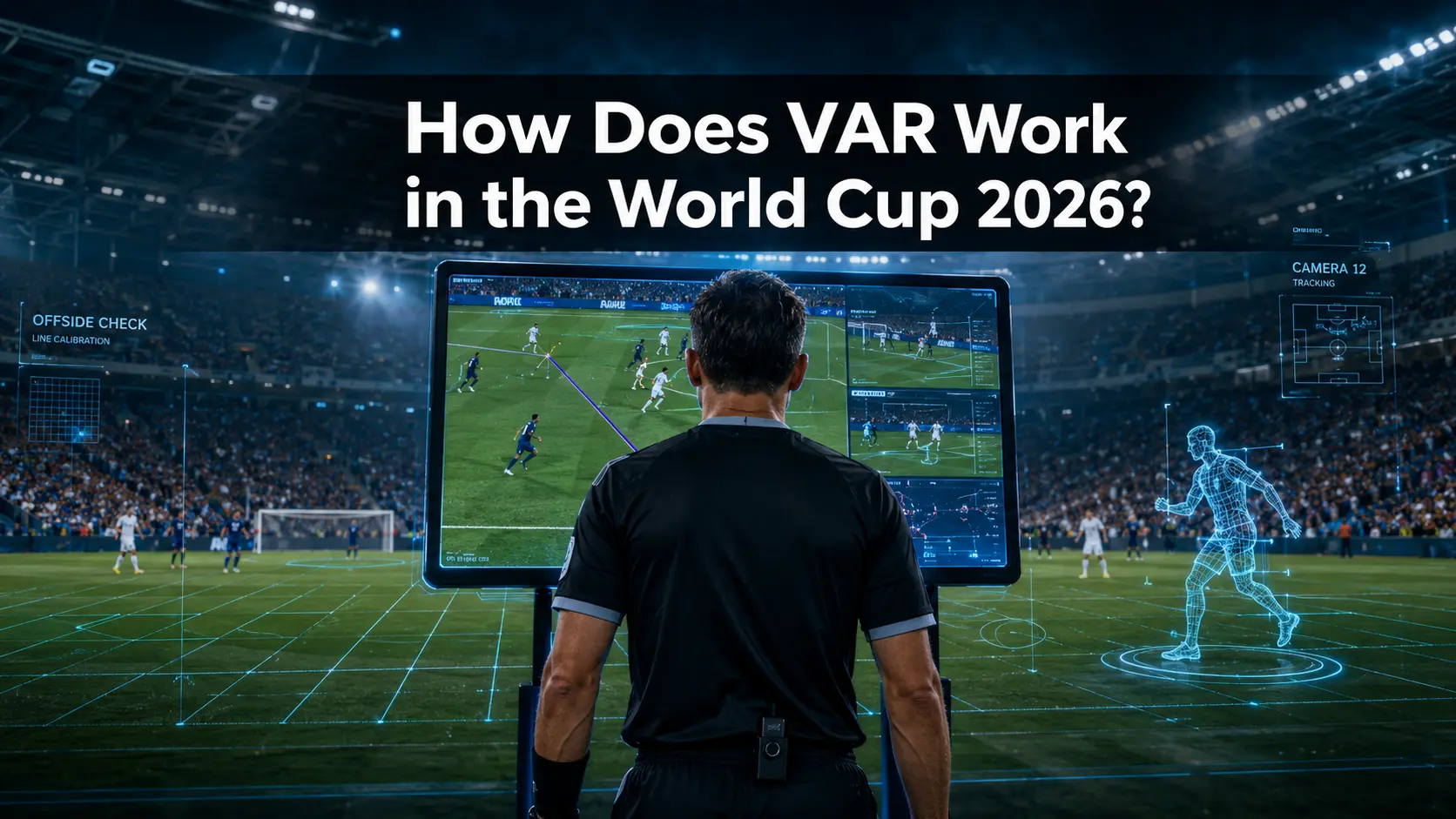
Fans keep asking the same question this summer: how does VAR work in the World Cup? The confusion is understandable. The 2026 tournament runs the most advanced officiating system football has ever seen. Yet its biggest story so far is a red card that a former referee called flatly wrong. This guide breaks down the full FIFA VAR protocol, the technology behind it, and the Balogun red card explained step by step. Readers will leave knowing exactly what the video assistant referee can review, how a decision unfolds, and why some calls cannot be appealed.
How Does VAR Work in Football?
VAR is a team of officials who watch every match on video and alert the referee to clear errors in four areas: goals, penalties, direct red cards, and mistaken identity. The on-field referee always makes the final decision.
That’s the short version. The longer version involves silent checks, pitchside monitors, and a strict intervention threshold. Each piece matters, so this article covers them one by one.
What Decisions Can VAR Review at the World Cup?
VAR can review only four match-changing situations: goals and the build-up to them, penalty decisions, direct red cards, and cases of mistaken identity.
Everything else stays with the on-field officials. Regular yellow cards, throw-ins, and midfield fouls are off-limits. These VAR review categories are deliberately narrow. The system exists to fix clear errors, not to re-referee the game.
There is one small expansion in 2026. With clear evidence, VAR can now act on a wrongly given second yellow card. It can also flag a corner awarded in error that leads directly to a goal.
Can a VAR Decision Be Appealed?
No. World Cup red cards and VAR decisions cannot be appealed. FIFA treats the VAR review itself as the first and only appeal.
This rule surprised many fans after the USMNT Balogun suspension. Teams can only contest an extension of a ban by the FIFA disciplinary panel, never the original card. More on that below.
Inside the FIFA VAR Protocol: Who Watches and How
Every match feeds into a video operations room. A lead VAR sits with assistant VARs (each AVAR monitors live play or specializes in offside) and replay operators. They have access to every broadcast angle plus dedicated offside cameras.
The process splits into two paths:
The Silent Check
Every goal, penalty shout, and possible red card gets checked automatically. Most checks finish in seconds while play continues. If no clear error appears, nothing happens. Fans often never know a check occurred.
On-Field Review Meaning: The Pitchside Monitor
For subjective calls, the VAR cannot decide alone. Instead, the team recommends an on-field review. The referee walks to the pitchside monitor, watches the footage, and makes the final call. The referee can reject the VAR’s recommendation. That is the on-field review meaning in simple terms: a recommendation, not an order.
Factual calls work differently. Positional offside, goal-line technology decisions, and ball-out-of-play checks need no monitor visit. The referee simply accepts the information.
The “Clear and Obvious Error” Threshold
VAR should only intervene when the on-field decision is clearly and obviously wrong. If reasonable officials could disagree, the original call stands. This threshold is the system’s most important guardrail. Keep it in mind for the controversy section.
One More Rule: Replay Speed
FIFA VAR protocol restricts slow-motion replay to one job: establishing the point of contact. The intensity of a challenge must be judged at normal speed. Why? Slow motion makes nearly every tackle look violent. This rule sits at the heart of the tournament’s biggest dispute.
VAR Rules 2026 World Cup: What’s New This Tournament
The 2026 edition upgrades almost every layer of the system. Here are the headline changes.
Semi-Automated Offside Technology 2026
The biggest change fixes the hated delayed flag. In 2022, offside data went to the VAR room first. Now, clear calls go straight to the officials on the pitch as instant audio alerts. Assistants can flag immediately.
Precision improved too. The upgraded offside technology resolves calls down to roughly 10 centimeters. FIFA 3D-scanned all 1,248 players to build lifelike 3D player avatars. Optical tracking cameras follow those avatars throughout every match. Broadcasters then use the same avatars for the replay graphics fans see on screen.
One limit applies. Instant alerts cover positional offside only. Whether a player is interfering with play remains a human judgment.
The Connected Ball
The Trionda match ball carries a ball sensor sampling motion 500 times per second. It tells officials the exact instant of every touch. That data sharpens offside, handball, and penalty checks.
Referee Body Cameras and Stadium Announcements
Referee body cameras run in all 104 matches for the first time. Fans get a first-person view of key moments. After each review, the referee also explains the decision over the stadium PA. These in-stadium announcements end the old guessing game.
Wider Rule Changes Around VAR
The tournament follows the 2025/26 IFAB Laws of the Game. The World Cup 2026 new rules include an eight-second goalkeeper limit, restart countdowns, and a red card for leaving the field in protest. These are not VAR rules, but they shape what fans see from officials.
Balogun Red Card Explained: The Tournament’s Defining Controversy
No VAR controversy World Cup 2026 has produced comes close to this one. Here is what happened, step by step.
The Incident
July 1, 2026. Round of 32. The United States led Bosnia-Herzegovina 2-0 in Santa Clara. In the 64th minute, striker Folarin Balogun challenged defender Tarik Muharemovic for the ball. Balogun’s cleat slid down the defender’s leg. Replays showed the ankle buckling. Referee Raphael Claus initially played on.
The Review
The VAR recommended an on-field review for serious foul play. Claus watched the pitchside monitor and showed a straight red card. Under VAR red card rules, the dismissal triggered an automatic suspension of one match. Balogun, the team’s top scorer, would miss the knockout stage clash with Belgium.
Where the Protocol Failed
Former Premier League referee Andy Davies analyzed the call for ESPN. His verdict was direct. The VAR built its recommendation on slow-motion and still images. Protocol says those tools establish contact points only. The nature of a challenge must be judged at full speed.
At normal speed, Davies saw an accidental collision between two players competing for the ball. In his view, it was never a red card offense. He added a second point. Once Claus saw those slow-motion frames at the monitor, a dismissal became almost inevitable. The framing of the review decided the outcome.
USMNT coach Mauricio Pochettino agreed, calling the action a normal football movement. Balogun himself said a yellow card would have been fair.
Can USA Appeal Balogun Red Card?
No. FIFA confirmed there is no mechanism for appeal. The VAR review counts as the appeal.
The risk actually runs the other way. The FIFA disciplinary panel can extend a one-match ban for severe offenses. It already did so this tournament. Qatar’s Assim Madibo received a five-game ban after a challenge broke Ismaël Koné’s leg. U.S. Soccer has said it will contest any extension beyond one game.
The Takeaway
The Balogun case does not prove VAR is broken. It proves VAR is human. The technology delivered perfect pictures. The people interpreting them skipped a safeguard. That distinction is the real lesson of this World Cup.
Helpful Tips: How to Read a VAR Decision Like an Expert
- Watch the first replay at full speed. Ask whether the contact still looks violent. If not, slow motion may be misleading the review.
- Note whether the referee visits the monitor. A monitor visit means a subjective call. No visit means a factual one.
- Listen to the stadium announcement. The stated offense (like serious foul play or mistaken identity) tells fans which review category applied.
- Remember the threshold. The question is never “was the referee right?” It is “was the referee clearly wrong?”
Facts and Figures: VAR at the 2026 World Cup
- 104 matches, all covered by VAR and referee body cameras
- 1,248 players 3D-scanned for offside avatars
- ~10 cm offside detection precision, down from ~50 cm
- 500 readings per second from the match ball sensor
- 4 review categories, unchanged since 2018
- 0 appeals allowed against on-field decisions
FAQs About VAR at the 2026 World Cup
Does VAR check every goal?
Yes. Every goal gets a silent check for offside, handball, and fouls in the build-up. Most checks finish before the celebrations end.
How long does a VAR check take?
Simple checks take seconds. On-field reviews usually take one to three minutes, depending on the angles needed.
Can the referee overrule VAR?
Yes. On subjective decisions, VAR only recommends. The referee makes the final call at the monitor.
Is offside automatic at the 2026 World Cup?
Partly. Clear positional offside triggers an instant alert to officials. Judging interference with play still requires humans.
What does “clear and obvious error” mean?
It means VAR should intervene only when the original decision is plainly wrong. Close calls stay with the referee.
Why was Balogun given a red card?
The VAR judged his contact on Muharemovic as serious foul play and recommended a review. The referee agreed at the monitor. Many experts believe the protocol was misapplied.
How many games will Balogun miss?
One match, unless the FIFA disciplinary panel extends the ban. The suspension rules him out of the round of 16 against Belgium.
What happens if VAR gets it wrong?
Nothing can reverse the decision during or after the match. FIFA reviews officiating performance internally, but results stand.
What are the new rules at the 2026 World Cup?
Instant offside alerts, referee announcements, body cameras, the eight-second goalkeeper rule, and restart countdowns lead the list.
Final Whistle: The Bottom Line
So, how does VAR work in the World Cup? Four review categories, silent checks, pitchside monitors, and one golden rule: intervene only for clear errors. The 2026 system adds instant offside alerts, a connected ball, and full transparency for fans. Yet the Balogun controversy shows that protocol discipline still matters more than any camera.
Football fans who understand these rules will watch the knockout rounds differently. Every flag, every monitor visit, and every announcement will make sense.