

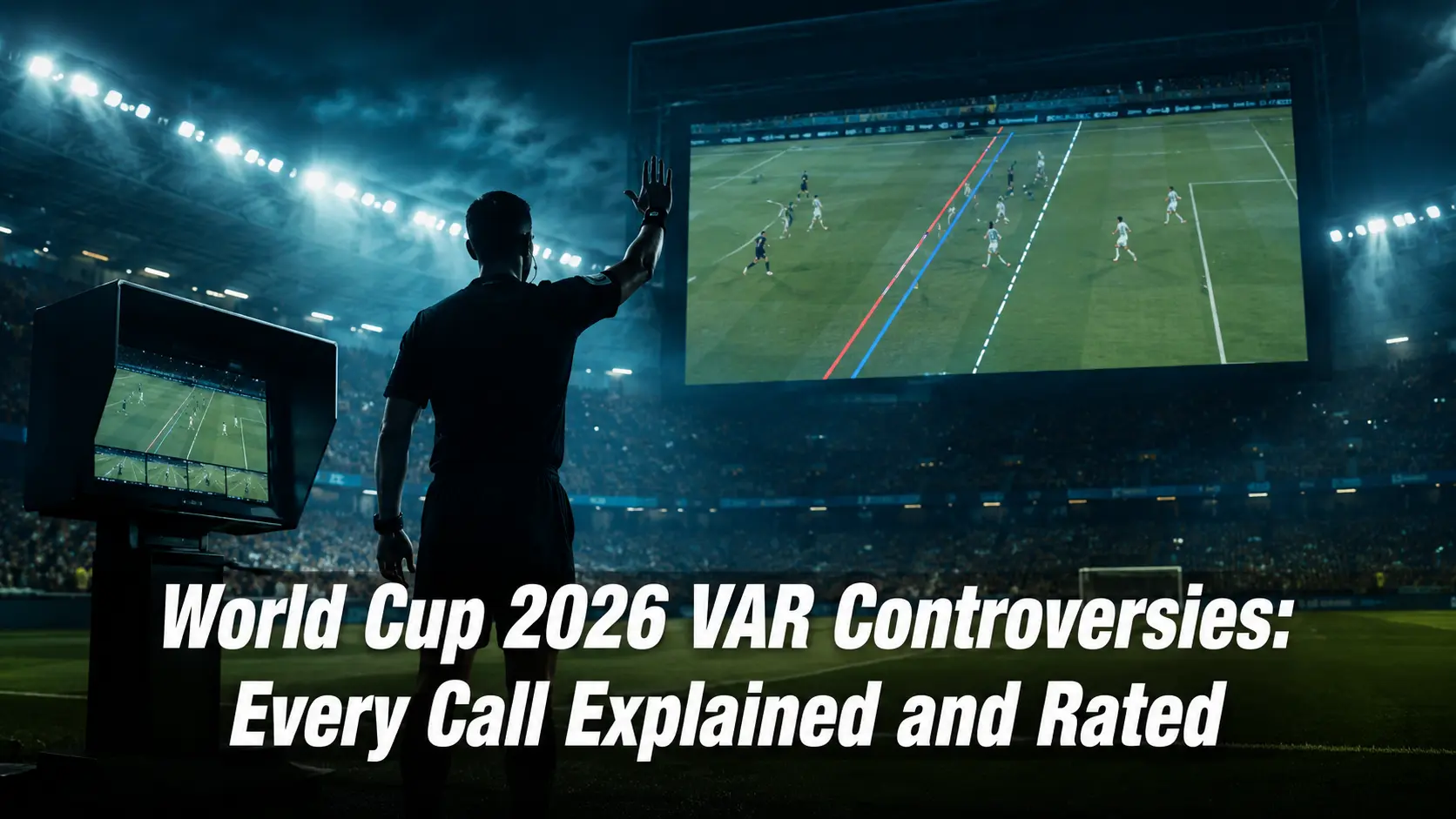
The World Cup 2026 VAR controversies keep piling up. Fans have watched goals vanish, penalties appear in the 118th minute, and one offside graphic fail to appear at all. Every match seems to add a new argument. That is why this page exists. It tracks every major VAR flashpoint of the tournament in one place, explains the decision, and rates whether the officials got it right. Follow along with our World Cup 2026 knockout bracket and results as the drama unfolds, and bookmark this page — the list below grows with every round.
Why Was Egypt’s Goal Against Argentina Disallowed?
Egypt’s goal was disallowed because VAR spotted a foul by Marwan Attia on Lisandro Martínez in the build-up, before Egypt broke away and scored.
Here is the longer version. Egypt led Argentina 1-0 in their round-of-16 clash in Atlanta. Then Mostafa Ziko finished a sweeping counter-attack to make it 2-0. The stadium erupted. Minutes later, the VAR called referee François Letexier to the monitor. Replays showed Attia holding Martínez’s shirt and stepping on his foot at the other end of the pitch. Letexier ruled that the foul started the move that led to the goal. The strike was chalked off.
Egypt never recovered. Argentina stormed back to win 3-2, and Lionel Messi scored the equaliser. Egypt coach Hossam Hassan called the outcome an injustice. The Egypt FA protest to FIFA followed a day later, with the federation saying it could not stay silent about the refereeing. Even TV pundits split down the middle. Some rules analysts backed the call. Former referee Mark Clattenburg argued there was no foul and no grounds for VAR to step in at all. Read our full Argentina vs Egypt match report and fallout for the complete story.
Can VAR Disallow a Goal for a Foul at the Other End of the Pitch?
Yes — but only when the foul happens in the same phase of play that directly leads to the goal.
This surprised many viewers during the Egypt game. Commentators on the broadcast even suggested the check went beyond VAR’s remit. It did not. Under the IFAB Laws of the Game and the VAR protocol, officials can review the attacking phase of play that produces a goal. If a clear foul launches that phase, the goal can be cancelled, no matter where the contact happened. So the answer to “can VAR check fouls in the build-up to a goal” is a firm yes. The real debate in Atlanta was whether the contact was a foul at all, not whether VAR was allowed to look.
World Cup 2026 VAR Controversies: Match by Match
Below is the running list. Each entry covers the incident, the decision, and a verdict rating from 1 (clear error) to 5 (clearly correct).
Iran Disallowed Goal vs Egypt (Group Stage)
Iran thought they had a stoppage-time winner when Shoja Khalilzadeh bundled the ball home in the 93rd minute. Semi-automated offside technology then measured the Khalilzadeh offside call at a matter of centimetres — his boot sat fractionally beyond the last defender. Heartbreaking, but factual. Al Jazeera ranked it among the most debated calls of the group stage. Verdict: 5/5. Correct, though the review took longer than the technology promised.
Ghana’s Penalty Appeal vs England (Group Stage)
Ezri Konsa lunged in on Prince Kwabena Adu inside the box and appeared to catch the striker’s knee. No penalty came, and VAR stayed silent. Ghana coach Carlos Queiroz joked afterwards that VAR had gone for a coffee. Verdict: 2/5. A strong shout that deserved at least an on-field review.
The Qatar Switzerland Offside Graphic Outage (Group Stage)
Breel Embolo scored a penalty for Switzerland after a review, but fans never saw the usual 3D offside animation for a tight call in the build-up. FIFA later blamed a brief technical outage for the missing VAR graphic in the Bay Area, insisting the attacker was onside. Pundits, including Gary Neville, demanded the evidence. Verdict: 2/5 for transparency. The decision may have been right, but nobody could verify it.
Germany Goal Disallowed vs Paraguay (Round of 32)
Jonathan Tah headed home in extra time, only for the Tah goal VAR review to find a foul by Waldemar Anton on the Paraguay goalkeeper. Julian Nagelsmann called the decision a joke. Germany then lost on penalties. FIFA defended the call, saying referees had pre-tournament instructions to punish goalkeeper blocking. The Germany goal disallowed Paraguay saga remains one of the tournament’s most disputed moments. Verdict: 3/5. Consistent with FIFA’s guidance, but a soft foul by any normal standard.
Gvardiol Goal Disallowed, Croatia vs Portugal (Round of 32)
Joško Gvardiol thought he had rescued Croatia in stoppage time. Instead, officials ruled a teammate offside earlier in the move. The key detail: connected ball technology sensors confirmed a slight touch that deflected off a defender’s head. Under Law 11, that deflection was not a deliberate play, so the offside stood. The Gvardiol goal disallowed Croatia Portugal decision showed how far the tech now reaches. Verdict: 4/5. Technically correct, even if it felt cruel.
Belgium Penalty vs Senegal Extra Time VAR Drama (Round of 32)
With penalties looming, Youri Tielemans went down under a challenge from Lamine Camara in the 118th minute. The referee saw nothing live. VAR recommended a monitor review, and Belgium won a decisive spot-kick. Senegal went home devastated. Verdict: 4/5. Late, dramatic, and defensible.
Kane Penalty Not Given, DR Congo vs England (Round of 32)
Harry Kane rounded goalkeeper Lionel Mpasi, felt contact, and went down. No penalty was given, and VAR did not intervene. ESPN’s officiating expert later argued England were unlucky and that the keeper clearly fouled Kane. Verdict: 2/5. Most neutrals felt this crossed the clear-error threshold.
Harry Kane Penalty Mexico VAR Double, England vs Mexico (Round of 16)
Kane sat at the centre of two more calls in Mexico City. First, England won a penalty when Raúl Rangel clattered Anthony Gordon — a routine check. Then came the reverse angle. Kane tried to clear inside his own box and kicked Brian Gutiérrez’s boot instead of the ball. After a monitor review, Mexico got a penalty of their own. Harsh on the England captain, but the replays showed no contact with the ball. Verdict: 4/5. Painful for England, correct in law.
Quansah Red Card VAR Review (Round of 16)
In the same round, England defender Jarell Quansah saw his challenge upgraded to a red card for serious foul play after the referee visited the screen. The review focused on the point of contact and the force involved. Verdict: 4/5. High contact, correct escalation.
Egypt Disallowed Goal VAR Storm vs Argentina (Round of 16)
The headline case, covered in full above. The Mostafa Ziko goal disallowed decision, the ignored late appeals involving Mohamed Salah, and the Enzo Fernández winner combined into the fiercest officiating row of the tournament. Al Jazeera’s breakdown of the second-half chaos captures just how heated it became. Verdict: 3/5. Defensible under protocol, but inconsistent with how physical contact was refereed all month.
How Does Semi-Automated Offside Technology Work?
SAOT uses limb-tracking cameras and a sensor inside the ball to detect offside positions automatically, then alerts the VAR within seconds.
Here is the process in plain terms. Dedicated cameras under the stadium roof track dozens of data points on every player’s body, many times per second. The system builds a live skeletal model of all 22 players. Meanwhile, an IMU sensor inside the match ball records the exact moment of every kick or touch. Combine the two, and the software knows precisely where each attacker stood when the ball was played. If the system flags an offside, the VAR validates it manually before the decision reaches the referee. Fans then see the familiar 3D offside animation on the big screen — outage days aside. For the full technical walkthrough, see our deep dive on how semi-automated offside technology works, or browse FIFA’s official football technology hub.
Why the Connected Ball Matters
The ball’s sensor settles arguments that cameras alone cannot. The Croatia decision proved it. Only the connected ball confirmed the faint touch that changed the offside line. That level of detail simply did not exist at previous tournaments.
VAR Rules World Cup 2026: What Can VAR Review?
So what can VAR review under the 2026 World Cup VAR protocol? Only four match-changing situations:
- Goals, including fouls or offsides in the attacking phase of play
- Penalty decisions
- Direct red cards, including DOGSO situations
- Cases of mistaken identity
Everything else stays with the on-field referee. That answers the common question of when can VAR intervene: only in those four areas, and only for a clear mistake. Our complete guide to the VAR rules at World Cup 2026 breaks down each category with examples.
Clear and Obvious Error Meaning
The clear and obvious error meaning trips up many fans. VAR does not exist to re-referee the game. A 50-50 foul, by definition, is not clear and obvious, so the on-field call stands. That is why Kane’s appeal against DR Congo survived, while factual offside calls get overturned by a toe. Offside is measured. Fouls are judged.
Have Refereeing Standards Shifted at This Tournament?
Many coaches think so. Referees allowed heavy physical contact through the group stage, then punished similar challenges in the knockouts. Clattenburg made exactly this point after the Egypt game. FIFA counters that its officials follow pre-tournament briefings, such as the goalkeeper-protection guidance behind the Germany call. Another visible change: fans hear the referee announcing VAR decisions over the stadium PA, part of FIFA’s transparency push. Whether the calls feel consistent is another matter — and the debate will run through the final.
Frequently Asked Questions
Who are the World Cup 2026 referees for the biggest calls?
FIFA selected an elite panel overseen by its Referees Committee. Names from this list keep appearing above, including François Letexier, Danny Makkelie, and Alireza Faghani. See our full World Cup 2026 referee profiles for backgrounds on each official.
Can teams appeal a VAR decision to FIFA?
Teams can lodge formal complaints, as the Egypt FA protest FIFA route shows. However, results never change retroactively. Protests mainly pressure FIFA on future appointments and standards.
Why don’t fans always see the offside graphic?
They should. The Qatar Switzerland offside graphic failure was blamed on a technical outage, and FIFA promised the issue was fixed quickly.
Has VAR intervened more in 2026 than in 2022?
The expanded 104-game format alone guarantees more total interventions. The knockout rounds in particular have produced a monitor review almost every match day.
The Bottom Line
Technology now decides World Cup knockout ties by millimetres and sensor readings. Some calls have been flawless. Others, like Egypt’s heartbreak in Atlanta, will be argued about for years. This page will keep explaining and rating every one of the World Cup 2026 VAR controversies until the trophy is lifted on July 19.