

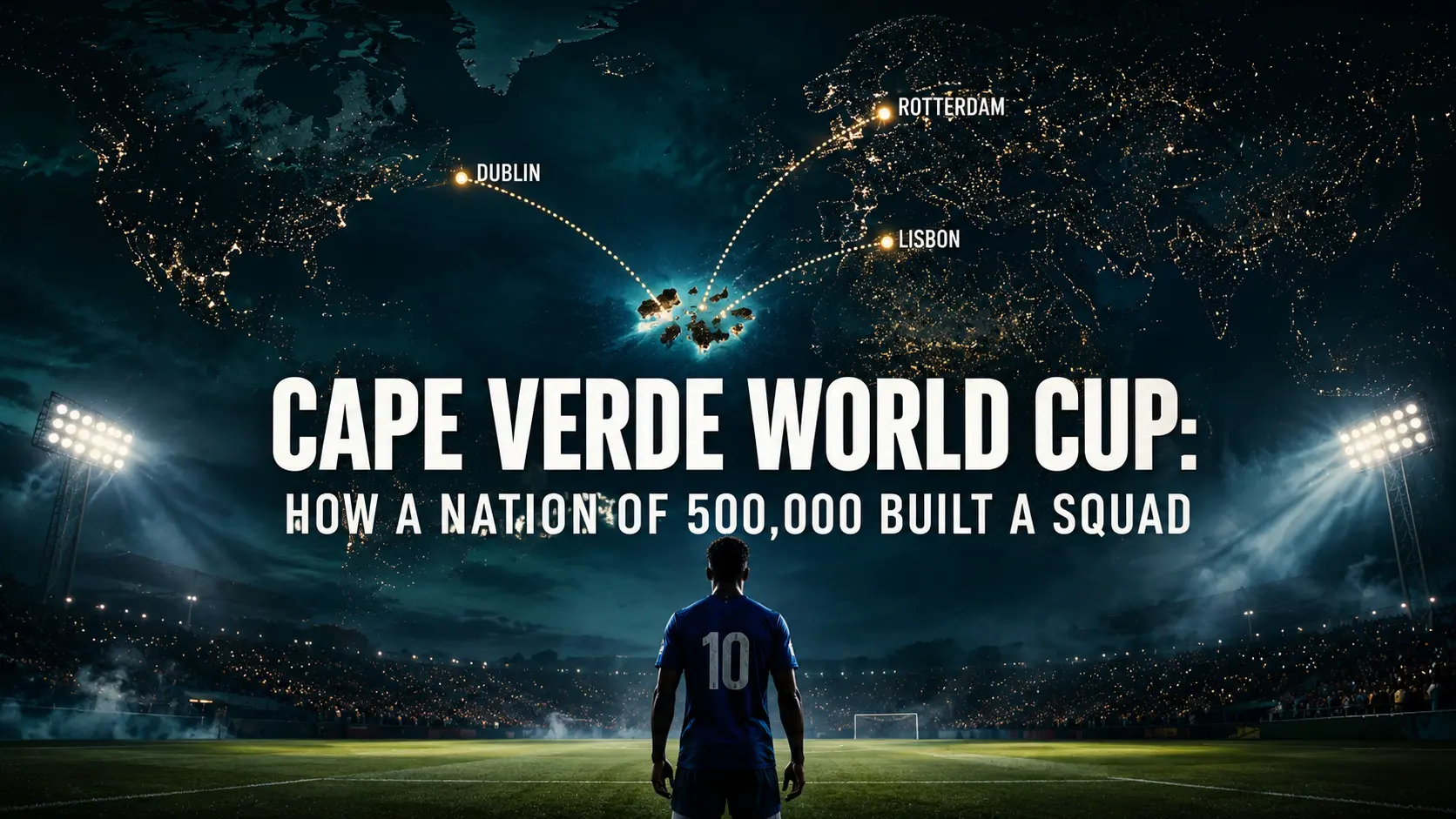
Something remarkable happened at the 2026 tournament. The Cape Verde World Cup story became the fairytale everyone was talking about. A tiny island nation of roughly 525,000 people held Spain, drew with Uruguay, and reached the knockout rounds. Then they pushed Lionel Messi’s Argentina into extra time. This article goes inside the diaspora project that made it all possible — the scouting, the FIFA eligibility rules, and the coach who tied it together.
How Did Cape Verde Qualify for the World Cup?
Cape Verde qualified for the 2026 World Cup by winning their CAF qualifying group ahead of Cameroon, sealing it with a 3–0 win over Eswatini on October 13, 2025.
The campaign was built on defense. The Blue Sharks kept seven clean sheets in ten qualifiers. A gritty home win over Cameroon proved the turning point. When the final whistle blew in Praia, history was made. The islands had reached football’s biggest stage for the first time. You can relive the full journey in our qualifying campaign recap.
That result also raised a bigger question. How did the smallest country to qualify for the World Cup in Africa’s history build such a squad? The answer lies far beyond the islands themselves.
A Nation Defined by Leaving
Cape Verde sits about 570 km off West Africa. The archipelago is beautiful but dry, and jobs have always been scarce. So for over a century, its people emigrated. They settled in Portugal, the Netherlands, France, Luxembourg, and New England in the United States.
Here is the astonishing part. More Cape Verdeans live abroad than on the islands. Estimates put the diaspora at around a million people — nearly double the home population. Every emigrant family became, in football terms, a potential academy.
For decades, that talent slipped away. Kids of Cape Verdean parents grew up in Dutch and Portuguese academies. The best played for the Netherlands or Portugal. The rest never played international football at all. That forgotten middle group became the foundation of the Cape Verde national football team.
The Cape Verde World Cup Squad: Built by the Diaspora
The numbers tell the story better than anything. Fourteen of the 26 players in the Cape Verde World Cup squad were born abroad. The roster drew from 25 clubs across 14 countries. Six players were born in one Dutch city alone.
Why Are So Many Cape Verde Players Born in Rotterdam?
Rotterdam’s port drew generations of Cape Verdean workers. Their community became one of the largest in Europe. Their sons grew up in the brilliant Dutch academy system. Remarkably, more squad members were born in Rotterdam than in Praia, the capital.
The Cape Verde players born in Rotterdam brought Eredivisie-standard schooling with them. Deroy Duarte, who scored against Argentina, came through that pipeline. So did striker Dailon Livramento, whose goals powered the qualifying run.
The Portuguese and Global Routes
The Lisbon connection runs even deeper. Captain Ryan Mendes, the team’s record scorer, developed in Portugal. Midfielder Kevin Pina plays his club football in Russia. Defender Roberto “Pico” Lopes was born in Dublin. The Cape Verde diaspora players truly span the globe.
The Federation’s Long Game
None of this happened by luck. The Cape Verde football federation (FCF) spent two decades building a borderless scouting network. Officials tracked players with Cape Verdean surnames through European academies and lower leagues. They verified family trees like corporate headhunters.
The most famous example? Pico Lopes was recruited through a LinkedIn message while playing for Shamrock Rovers in Ireland. One message changed his life. He became a defensive cornerstone and a star of the group stage.
Funding mattered too. FIFA’s Forward program covered travel costs for a squad scattered across three continents. It paid for training facilities at home. For a micro-federation, that support was the skeleton holding everything up.
Persuasion was the hardest part. Choosing the islands meant longer flights and smaller fees. So the FCF sold identity instead — the Creole language, family roots, and morabeza, the islands’ famous ethic of warmth. Each committed player then recruited the next one.
FIFA Eligibility Rules: The Rulebook Behind the Project
The project only works because of FIFA eligibility rules. A player qualifies for a nation through birth, a parent or grandparent born there, or residency. Cape Verdean law grants citizenship by descent generously. A Rotterdam-born grandson of emigrants can hold a Cape Verdean passport.
The 2020 FIFA reforms changed everything. Players capped in up to three competitive senior games before age 21 can now switch nations once. Youth caps never tie a player at all. Suddenly, discarded heritage players became a renewable resource. The FCF built the paperwork machine to claim them.
Bubista: The Cape Verde Coach Who Made It Work
Recruiting talent is one thing. Building a team from strangers is another. Enter Pedro Leitão Brito, known to everyone as Bubista, the Cape Verde coach since 2020.
Bubista captained the national team for over a decade as a player. Born on Boa Vista, he understood both the islands and the emigrant families. That credibility solved the trust problem instantly. Players from top leagues and tiny leagues alike accepted his authority.
His camps felt like family reunions, not business trips. Club status meant nothing inside the group. His tactics were humble and ruthless — a compact defensive block with fast transitions. He took the team to the 2023 AFCON quarter-finals. Then he took them to history, earning CAF Coach of the Year honors along the way.
The Cape Verde World Cup Run: Match by Match
Then June 2026 arrived, and theory became proof.
Cape Verde vs Spain (0–0, June 15). In their first ever World Cup match, the debutants shut out the European champions. Goalkeeper Vozinha, aged 40, made seven saves and won man of the match.
Uruguay 2–2 Cape Verde (June 21). Kevin Pina scored the nation’s first World Cup goal with a 30-yard free kick. Hélio Varela pounced on an error to equalize late.
Cape Verde 0–0 Saudi Arabia (June 27). A third draw sent the Blue Sharks through as Group H runners-up. They became the smallest nation ever to reach the men’s knockout stage. No debutant had done it since Slovakia in 2010.
Cape Verde vs Argentina (2–3 a.e.t., July 3). The champions needed 120 minutes and an own goal to survive. Deroy Duarte and Sidny Lopes Cabral both equalized, Cabral with a strike for the ages. Vozinha made ten saves, five from Messi himself. The dream ended, but the point was made.
The Blueprint for Small Nations
Other federations are already taking notes. Curaçao ran a parallel project through the Dutch system in 2026. The formula is simple to describe and hard to execute:
- Map the diaspora like a market, not a mailing list.
- Master the eligibility rulebook before rivals do.
- Hire a coach the community trusts, not a celebrity.
- Build the team on defense and shared identity.
- Let every famous result recruit the next player.
Cape Verde did not import a team. It brought one home.
FAQs
Is Cape Verde the smallest country to play at a World Cup?
By population, it was the third-smallest ever to qualify, behind Iceland and Curaçao. But it became the smallest nation ever to reach the men’s knockout stage.
How many Cape Verde players were born abroad?
Fourteen of the 26-man squad, including six born in Rotterdam.
Who scored Cape Verde’s first World Cup goal?
Kevin Pina, with a long-range free kick against Uruguay on June 21, 2026.
Who is Vozinha?
The 40-year-old goalkeeper who starred against Spain and made ten saves against Argentina.
Can a player switch national teams under FIFA rules?
Yes, once — if they played three or fewer competitive senior games before turning 21, among other conditions.
Final Whistle
The Cape Verde World Cup adventure ended in Miami, but its legacy is only beginning. A federation with almost no money out-thought the football world. It found its team in Rotterdam apartments, Lisbon academies, and Dublin dressing rooms. Small nations everywhere now have a blueprint worth copying.
Want more stories like this? Subscribe to the newsletter for weekly deep dives into football’s smartest underdogs. And if you enjoyed this piece, share it with a fellow fan who loves a giant-killing.