


When the final whistle blew at Atlanta Stadium on June 15, 2026, Cape Verde goalkeeper Vozinha did not run to celebrate with his teammates. He hunched over near his goalpost, buried his face, and wept. Most people watching assumed those were tears of joy. And honestly, some of them were. But the full story behind that moment is something else entirely. It goes back to a childhood on a small island, a nickname that started as a playground taunt, a mother who could not get a visa in time, and two grandparents who passed away before they could ever see this day.
This is the story of the man the world now knows as Vozinha. Where that name came from, what it actually means, and why it meant so much more than a clean sheet against Spain.
Who Is Vozinha? The Real Name Behind the Legend
Most people had never heard the name Vozinha before Cape Verde’s stunning 0-0 draw against Spain at the 2026 FIFA World Cup. Within 90 minutes, that changed completely. The 40-year-old goalkeeper pulled off seven saves against one of the strongest teams in the tournament, walked away with the Player of the Match award, and watched his Instagram followers jump from 50,000 to nearly 10 million in less than two days.
But here is the thing. Vozinha is not actually his real name. His full name is Josimar José Évora Dias, born on June 3, 1986, in the coastal city of Mindelo on the island of São Vicente, Cape Verde. The nickname Vozinha has been with him since he was a kid and once you learn what it actually means, the story of his World Cup debut hits very differently.
What Does Vozinha Mean in Portuguese?
So what does vozinha actually mean in Portuguese? It translates to “little granny” or “little grandmother.” It comes from the word vó, which simply means grandmother in Portuguese. For a professional goalkeeper playing at the World Cup, it is a pretty unusual nickname. But the story behind it is honestly one of the most touching things to come out of this tournament.
Growing up in São Vicente, young Josimar did not have the typical childhood setup. His father was away serving in the military and his mother was out working to keep the family going. So his grandparents stepped in. They raised him. They were his people.
After school, he would head out and play street football with older kids in the neighbourhood. Being the youngest and smallest, he lost a lot. And when he lost, he went home. Home to his grandparents.
The older kids noticed. They started winding him up, joking that he would go running back to grandma whenever things did not go his way on the pitch. Kids being kids, the nickname Vozinha, little granny, started getting thrown around. It was a taunt. A bit of playground mockery aimed at a small boy who loved his grandparents.
Nobody on that street in São Vicente could have imagined that forty years later, that same boy would walk out at the FIFA World Cup with that very name on the back of his shirt.
From a Taunt to a Jersey: How the Nickname Became an Identity
When Josimar José Évora Dias moved to Angola to kick off his professional career abroad, he hit a small but significant problem almost immediately. There was already a goalkeeper at his new club called Josimar.
Going by “Josimar II” on the back of his shirt was never really an option for him. It did not feel right. Back home in Cape Verde, everyone already knew him as Vozinha. That was his name. That was who he was. So that is exactly what went on his jersey.
“If everyone knew me as Vozinha in Cape Verde, that’s what I would be,” he later said to FIFA.
It was not about building a brand or standing out for the sake of it. It was just a young man from a small island holding onto the name his home had given him, even though that name had originally been used to tease him as a kid. Without really thinking about it, he took something that was meant to put him down and made it the thing he would one day be celebrated for. That says a lot about Cape Verdean resilience without needing to say very much at all.
A Journeyman’s Path: The Career Nobody Tracked
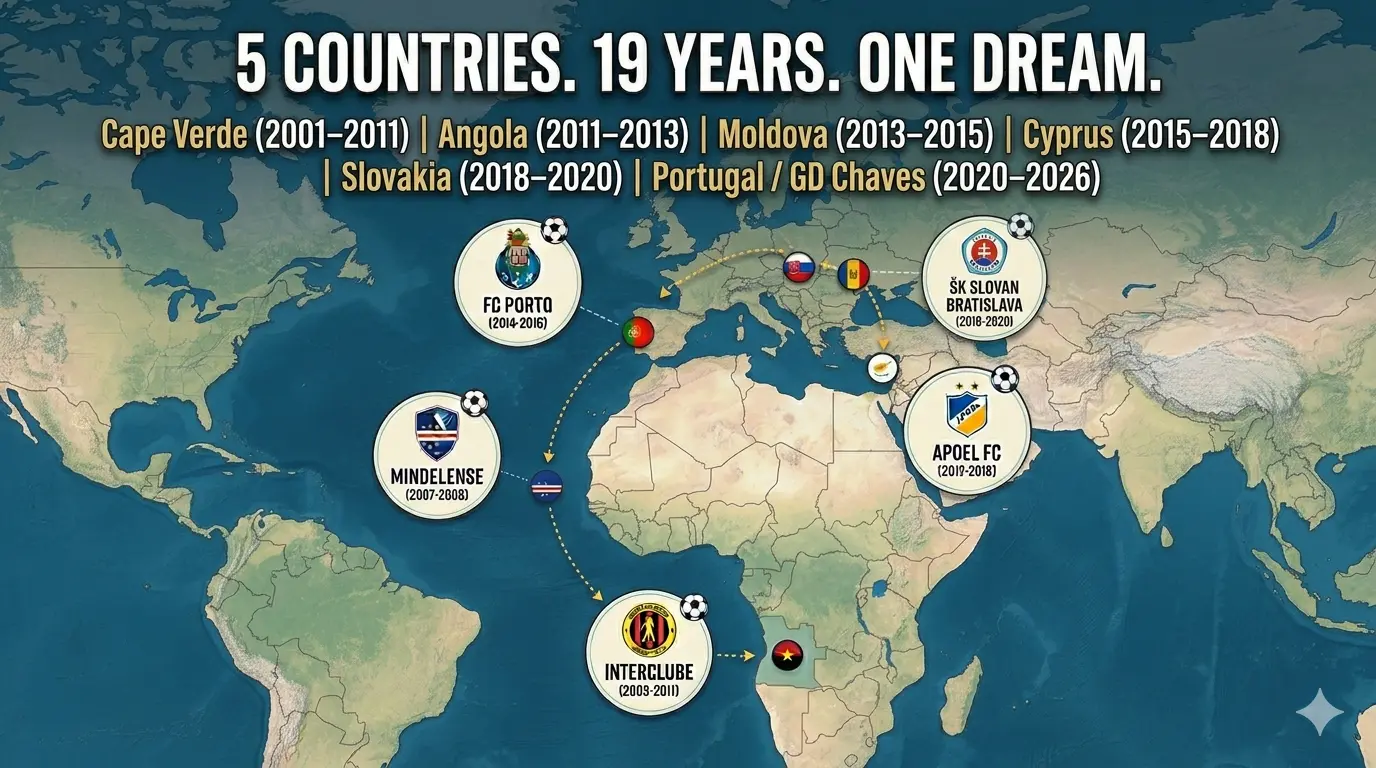
To really understand what Vozinha’s World Cup debut meant, you have to understand how long it took him to get there. Most players who show up at tournaments like this have spent years at elite clubs in Europe’s biggest leagues. Vozinha’s path looked nothing like that. He did not even turn professional until he was 25, which in football terms makes him one of the most unlikely success stories you will ever come across.
His career took him everywhere. Batuque FC and CS Mindelense back home in Cape Verde. Progresso in Angola. Zimbru Chisinău in Moldova. Gil Vicente in Portugal. AEL Limassol in Cyprus. AS Trencín in Slovakia. And finally GD Chaves in Portugal’s second division, where he spent his last two seasons as a club player. Some of those clubs are so far off the radar that statistics websites never fully tracked his appearances. That is the kind of career it was.
He joined the Cape Verde national team back in 2012 and racked up 90 international caps before the Spain match. There were AFCON qualifications, long trips, and years of playing in relative anonymity. There were times he thought about stepping away from international football for good.
He stayed. Because of a dream. And that dream was always the World Cup.
The Grandparents Who Were Everything — And Are No Longer Here
When reporters asked Vozinha after the match why he had been crying, nobody expected the answer he gave.
He did not talk about the result. He did not talk about Spain or the saves or the clean sheet.
He talked about his grandparents.
The couple who had raised him in São Vicente, the very people the older kids used to joke about him running home to, were no longer alive. They passed away before the 2026 World Cup ever happened. They never got to see their grandson become one of the most talked-about names in world football. They never got to watch him hold Spain out for 90 minutes on the biggest stage the sport has to offer.
“I cried because I grew up with my grandparents and, unfortunately, they were not here,” he told reporters. “They were everything for me, for my life.”
Think about that for a second. The nickname on his shirt, Vozinha, little granny, was given to him because of those grandparents. It started as a joke. It followed him across five countries and nineteen years of professional football. And on the night he finally made it to the World Cup, that name was on his back and they were not there to see it. A dream delayed is not a dream denied. But sometimes the people you most wanted to share it with are no longer around when it arrives.
The Visa That Kept His Mother Away
The tears for his grandparents were not the only grief Vozinha carried that day.
His mother was still alive. She knew the match was happening. She wanted to be there. But she was not in the stadium.
The reason is one of the most quietly heartbreaking details of an already emotional story. The cost and complexity of the visa application process meant that by the time everything was sorted, it was simply too late. The money, the paperwork, the timing. It all came together just a little too slowly. His mother watched from afar on the day her son made Cape Verde history.
“My mum didn’t manage to be here because of the visa,” Vozinha said. “The money for the visa, we didn’t manage on time. I would like her to be here. But I’m also very happy.“
That final line, “I’m also very happy,” says a great deal about the kind of person Vozinha is. He did not dwell in bitterness. He held both truths at once, the grief of absence and the joy of the moment. That is the kind of emotional maturity that comes from a life spent navigating far more lows than highs and learning to carry both with grace.
For many fans who heard the story, the visa issue touched something much broader as well. Cape Verde is the third smallest nation by population ever to qualify for a World Cup. It is a small island nation in the Atlantic where international travel is not simple or cheap. The barriers that kept a mother from watching her son at the World Cup are not unique to Vozinha’s family. They are a reality for countless families from smaller nations who face the same walls every time they try to follow their loved ones onto the world stage.
I Work All My Life for This Dream
What makes the fairytale of Vozinha’s World Cup debut so resonant is not just the result on the pitch. It is the sheer length of time it took to get there.
He was 40 years old. His contract with GD Chaves was set to expire at the end of June 2026, the same month as the World Cup. He had spent nineteen years as a professional footballer without ever reaching this stage. Cape Verde had never qualified before. A lot of generations had carried this dream and never seen it come true.
“I work all my life for this, for this moment, for this dream,” Vozinha said after the match. “A lot of generations in the past dreamed of this day but they did not achieve. And now the dream comes true.”
Those words carry extra meaning when placed alongside the nickname story. The boy who was mocked for running home to his grandma grew up to be the man who carried his grandparents’ memory onto the world stage. The older kids who gave him that taunt probably never imagined the name they invented would one day trend across the entire globe.
He became the oldest goalkeeper to keep a clean sheet on his World Cup debut. He earned the Player of the Match award against a Spain squad full of elite talent. He held his line through 27 shots, one save after another, until the whistle blew and a small island nation had its first ever World Cup point.
What the Name Vozinha Means Now?
Before June 15, 2026, typing Vozinha into a search engine would have given you almost nothing outside of Cape Verde football pages. Now it is one of the most searched names on the planet.
The goalkeeper from Mindelo. The 40-year-old who only went professional at 25. The man who held Spain to a 0-0 draw at his first ever World Cup with his grandparents’ nickname on his back and his mother watching from home because a visa came through too late. That is who Vozinha is.
His story is really about identity. About the names we carry and what they mean by the time we are done with them. About grandparents who raise us and never get to see how far we go. About mothers who want to be there and cannot always make it. About what it actually takes to keep chasing something for nineteen years when almost nobody is watching.
The name Vozinha started as a taunt on a street in São Vicente. It ended up on the back of a shirt at the FIFA World Cup 2026. And now, the whole world knows exactly what it means.
FAQ: Everything You’ve Been Searching For
1. What does Vozinha mean?
Vozinha is a Portuguese word meaning “little granny” or “little grandmother.” It is a childhood nickname given to Cape Verde goalkeeper Josimar José Évora Dias by older kids who teased him for going home to his grandparents after losing street football matches.
2. What is Vozinha’s real name?
Vozinha’s real name is Josimar José Évora Dias. He was born on June 3, 1986, in Mindelo, São Vicente, Cape Verde.
3. Why did Vozinha cry after the Spain match?
Vozinha cried after Cape Verde’s historic 0–0 draw with Spain at the 2026 World Cup because he was thinking of his grandparents, who raised him and have since passed away, and because his mother was unable to attend the match due to visa complications and cost.
4. Why couldn’t Vozinha’s mother attend the World Cup?
Vozinha’s mother could not attend because the visa application process and associated costs meant the paperwork was not completed in time for her to travel to the United States for the match.
5. How old is Vozinha?
Vozinha was 40 years old at the time of his World Cup debut against Spain on June 15, 2026, making him the oldest goalkeeper to keep a clean sheet on his World Cup debut.
6. Where is Vozinha from?
Vozinha is from Mindelo, on the island of São Vicente, in Cape Verde — an island nation off the northwest coast of Africa.